The Semiconductor Race: Why Chips Are the New Oil in Global Politics
Introduction: The Invisible Engine of the Modern World
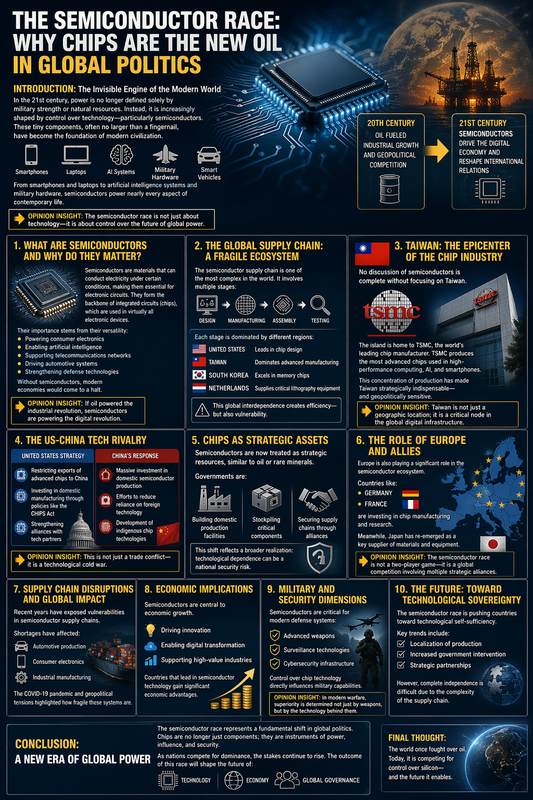
In the 21st century, power is no longer defined solely by military strength or natural resources. Instead, it is increasingly shaped by control over technology—particularly semiconductors. These tiny components, often no larger than a fingernail, have become the foundation of modern civilization. From smartphones and laptops to artificial intelligence systems and military hardware, semiconductors power nearly every aspect of contemporary life.
Today, semiconductors are often referred to as the “new oil.” This comparison is not merely symbolic; it reflects a deeper transformation in global power dynamics. Just as oil fueled industrial growth and geopolitical competition in the 20th century, semiconductors are now driving the digital economy and reshaping international relations.
At the center of this transformation are major global players like United States, China, and Taiwan, each competing for dominance in semiconductor production and innovation.
Opinion Insight:
The semiconductor race is not just about technology—it is about control over the future of global power.
1. What Are Semiconductors and Why Do They Matter?
Semiconductors are materials that can conduct electricity under certain conditions, making them essential for electronic circuits. They form the backbone of integrated circuits (chips), which are used in virtually all electronic devices.
Their importance stems from their versatility:
- Powering consumer electronics
- Enabling artificial intelligence
- Supporting telecommunications networks
- Driving automotive systems
- Strengthening defense technologies
Without semiconductors, modern economies would come to a halt.
Opinion Insight:
If oil powered the industrial revolution, semiconductors are powering the digital revolution.
2. The Global Supply Chain: A Fragile Ecosystem
The semiconductor supply chain is one of the most complex in the world. It involves multiple stages:
- Design
- Manufacturing
- Assembly
- Testing
Each stage is dominated by different regions:
- United States leads in chip design
- Taiwan dominates advanced manufacturing
- South Korea excels in memory chips
- Netherlands supplies critical lithography equipment
This global interdependence creates efficiency—but also vulnerability.
3. Taiwan: The Epicenter of the Chip Industry
No discussion of semiconductors is complete without focusing on Taiwan.
The island is home to TSMC, the world’s leading chip manufacturer. TSMC produces the most advanced chips used in high-performance computing, AI, and smartphones.
This concentration of production has made Taiwan strategically indispensable—and geopolitically sensitive.
Opinion Insight:
Taiwan is not just a geographic location; it is a critical node in the global digital infrastructure.
4. The US-China Tech Rivalry
The semiconductor race is most visible in the rivalry between the United States and China.
United States Strategy:
- Restricting exports of advanced chips to China
- Investing in domestic manufacturing through policies like the CHIPS Act
- Strengthening alliances with tech partners
China’s Response:
- Massive investment in domestic semiconductor production
- Efforts to reduce reliance on foreign technology
- Development of indigenous chip technologies
Opinion Insight:
This is not just a trade conflict—it is a technological cold war.
5. Chips as Strategic Assets
Semiconductors are now treated as strategic resources, similar to oil or rare minerals.
Governments are:
- Building domestic production facilities
- Stockpiling critical components
- Securing supply chains through alliances
This shift reflects a broader realization: technological dependence can be a national security risk.
6. The Role of Europe and Allies
Europe is also playing a significant role in the semiconductor ecosystem.
Countries like:
are investing in chip manufacturing and research.
Meanwhile, Japan has re-emerged as a key supplier of materials and equipment.
Opinion Insight:
The semiconductor race is not a two-player game—it is a global competition involving multiple strategic alliances.
7. Supply Chain Disruptions and Global Impact
Recent years have exposed vulnerabilities in semiconductor supply chains.
Shortages have affected:
- Automotive production
- Consumer electronics
- Industrial manufacturing
The COVID-19 pandemic and geopolitical tensions highlighted how fragile these systems are.
8. Economic Implications
Semiconductors are central to economic growth.
Their impact includes:
- Driving innovation
- Enabling digital transformation
- Supporting high-value industries
Countries that lead in semiconductor technology gain significant economic advantages.
9. Military and Security Dimensions
Semiconductors are critical for modern defense systems:
- Advanced weapons
- Surveillance technologies
- Cybersecurity infrastructure
Control over chip technology directly influences military capabilities.
Opinion Insight:
In modern warfare, superiority is determined not just by weapons, but by the technology behind them.
10. The Future: Toward Technological Sovereignty
The semiconductor race is pushing countries toward technological self-sufficiency.
Key trends include:
- Localization of production
- Increased government intervention
- Strategic partnerships
However, complete independence is difficult due to the complexity of the supply chain.
Conclusion: A New Era of Global Power
The semiconductor race represents a fundamental shift in global politics. Chips are no longer just components; they are instruments of power, influence, and security.
As nations compete for dominance, the stakes continue to rise. The outcome of this race will shape the future of:
- Technology
- Global governance
Final Thought:
The world once fought over oil. Today, it is competing for control over silicon—and the future it enables.
You can read more:
-Future Tech Innovations That Will Change Humanity in the Next 50 Years
-How Artificial Intelligence Is Transforming Daily Life Across the World
-Global Cybersecurity Challenges in the Digital Era: Protecting Data and Digital Infrastructure
-The Human Perspective on Artificial Intelligence: How AI Is Changing Work, Society and the Future



Comments
Post a Comment