Who Controls AI? Europe, US, and China in a Global Tech Battle
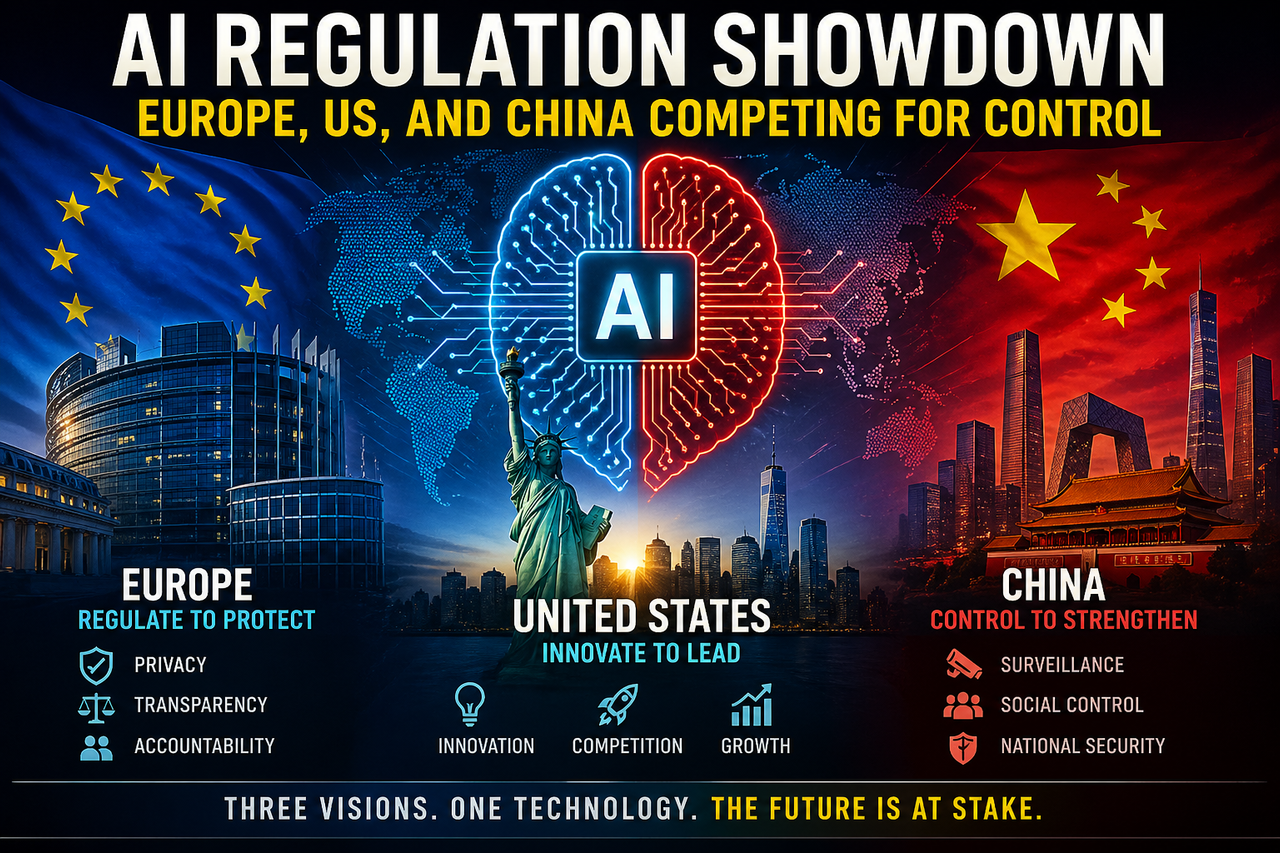
AI Regulation Showdown: Europe, US, and China Competing for Control
Introduction: The Struggle to Govern Intelligence
There are moments in history when a single technological shift forces the world to rethink power itself. The industrial revolution did this with machinery. The 20th century did it with oil and nuclear capability. Now, in 2026, artificial intelligence is triggering a transformation just as profound—if not more so.
But unlike past technologies, artificial intelligence is not just a tool. It is a system that can learn, decide, optimize, and influence human behavior at scale. That makes regulating it far more complex than regulating energy, weapons, or even the internet.
What we are witnessing today is not simply the development of AI, but a global struggle over who gets to define its limits, its purpose, and its power.
Three major forces are leading this contest:
- European Union
- United States
- China
Each represents a distinct philosophy. Each is shaping AI according to its own priorities. And each believes its model should define the global standard.
My core argument:
This is not just a policy debate—it is a civilizational contest over how intelligence itself will be governed in the digital age.
1. From Code to Power: Why AI Is Different
Artificial intelligence differs from previous technologies in one crucial way: it is not static. It evolves. It improves. It adapts.
A machine learning system deployed today will not behave exactly the same tomorrow. It refines itself based on data, interactions, and feedback loops.
This creates a regulatory challenge that governments have never faced before:
- How do you regulate something that changes constantly?
- How do you audit decisions made by systems that even their creators may not fully understand?
- How do you assign responsibility when outcomes are probabilistic rather than deterministic?
My opinion:
Most current regulatory frameworks are built for predictable systems. AI is fundamentally unpredictable. That mismatch is at the heart of today’s regulatory struggle.
2. Europe’s Strategy: Regulation as Global Influence
The European Union has taken the most structured and proactive approach to AI governance.
Through the EU AI Act, Europe has introduced a comprehensive framework that categorizes AI systems based on risk levels:
- Minimal risk
- Limited risk
- High risk
- Unacceptable risk
This classification determines what developers can build, how systems must be tested, and what obligations companies must meet before deployment.
Why Europe Leads in Regulation
Europe’s strength lies not in dominating AI innovation, but in shaping global norms. This is not new. The EU has already influenced global standards in:
- Data privacy
- Digital competition
- Consumer protection
My perspective:
Europe has discovered a unique form of power:
- If you cannot dominate the technology, dominate the rules governing it.
This is often referred to as the “Brussels Effect,” where EU regulations become global standards because companies prefer to comply universally rather than operate under fragmented rules.
The Strength—and Weakness—of Europe’s Model
Europe’s approach creates:
- Trust
- Accountability
- Predictability
But it also risks:
- Slower innovation
- Reduced competitiveness
- Regulatory complexity
My opinion:
Europe may win the rules battle, but not necessarily the innovation race.
3. The United States: Innovation Above All
The United States remains the global leader in AI innovation.
Companies like:
- OpenAI
- Microsoft
are pushing the boundaries of what AI can do.
The American Approach
Unlike Europe, the U.S. has taken a more flexible path:
- Encourage innovation first
- Introduce regulation gradually
- Allow market forces to shape development
This model prioritizes speed and technological leadership.
My perspective:
The U.S. is operating under a strategic assumption:
- Whoever leads in capability will ultimately shape the rules anyway.
The Risk Factor
However, this approach comes with significant risks:
- Lack of early safeguards
- Concentration of power in large tech firms
- Ethical dilemmas emerging faster than policies can adapt
My opinion:
The U.S. model is powerful—but reactive. It solves problems after they emerge, not before.
4. China’s Model: State-Controlled Intelligence
China represents a third, fundamentally different approach.
Rather than balancing innovation and regulation, China integrates AI directly into state governance.
Key Features
- Centralized data ecosystems
- Strong regulatory oversight
- Alignment with national strategic goals
- Rapid deployment across society
AI in China is not just a commercial tool—it is part of a broader system of governance.
My perspective:
China is not asking “How should we regulate AI?”
It is asking:
- How can AI reinforce state capacity and control?
Strengths and Trade-offs
- Fast implementation
- Large-scale data access
- Strategic coordination
- Limited transparency
- Reduced openness
- Ethical concerns
My opinion:
China’s model may be the most efficient—but also the most controversial.
5. Three Systems, One World: The Emerging Divide
The most striking outcome of this competition is not who is winning—but how different the approaches are.
We are not moving toward a single global standard.
We are moving toward three parallel AI ecosystems:
- A regulated European model
- A market-driven American model
- A state-controlled Chinese model
My opinion:
This is the beginning of a fragmented AI world, where systems operate under different rules, values, and objectives.
6. The Rise of Digital Sovereignty
As AI becomes central to national power, countries are increasingly seeking control over their digital ecosystems.
This concept—digital sovereignty—includes:
- Control over data
- Regulation of AI systems
- Protection from foreign technological influence
Governments are now treating data and algorithms as strategic assets.
My perspective:
Data is becoming the new territory. And AI is the tool used to govern it.
7. Tech Companies: The New Power Brokers
One of the most overlooked aspects of AI governance is the role of corporations.
Companies like:
- OpenAI
- Microsoft
are not just participants—they are architects of the AI ecosystem.
My opinion:
In many ways, governments are trying to regulate systems they did not create and do not fully control.
This creates a new dynamic:
- Governments set rules
- Companies build reality
8. Ethics vs Power: An Unresolved Conflict
AI regulation is often framed as an ethical issue—but it is equally a strategic one.
- Europe emphasizes ethics
- The U.S. emphasizes innovation
- China emphasizes control
My perspective:
Ethics and power are not always aligned.
- A country that prioritizes ethics may fall behind technologically.
- A country that prioritizes power may ignore ethical risks.
Balancing these is the central challenge of AI governance.
9. The Risk of Overcorrection
There is a growing danger on both sides:
- Overregulation
- Slows innovation
- Drives talent elsewhere
- Creates bureaucratic barriers
- Underregulation
- Enables misuse
- Increases systemic risk
- Concentrates power
My opinion:
The real challenge is not choosing one extreme—it is managing a constantly shifting balance.
10. What Comes Next: A World Without Consensus?
Looking ahead, several trends are emerging:
- Regional AI standards will diverge
- Cross-border cooperation will become more complex
- AI governance will become a core diplomatic issue
The key question is whether global cooperation is still possible.
My perspective:
The world is not moving toward consensus. It is moving toward coexistence with tension.
Conclusion: Who Controls Intelligence?
The AI regulation showdown between the European Union, United States, and China is one of the defining developments of our time.
This is not just about technology. It is about:
- Power
- Governance
- The future structure of society
Final Thought (My View):
- We are no longer just building intelligent machines.
- We are deciding who gets to control intelligence itself.
And once that control is established, it will shape the global order for decades to come.
You can read more:
-The Global Chip War: How Semiconductors Control the Future
-How Artificial Intelligence Is Transforming Daily Life Across the World
-Global Cybersecurity Challenges in the Digital Era: Protecting Data and Digital Infrastructure
-Net5.5G Revolution Unveiled at MWC 2026: Global Broadband Enters AI Era
-The Human Perspective on Artificial Intelligence: How AI Is Changing Work, Society and the Future


Comments
Post a Comment