Climate Vulnerability in Coastal Bangladesh: Risks, Impacts, and a Personal Perspective on the Future
Introduction: Living With Climate Reality, Not Climate Theory
Bangladesh is often described in global reports as one of the most climate-vulnerable countries. But from my perspective, that label—while accurate—only captures part of the story.
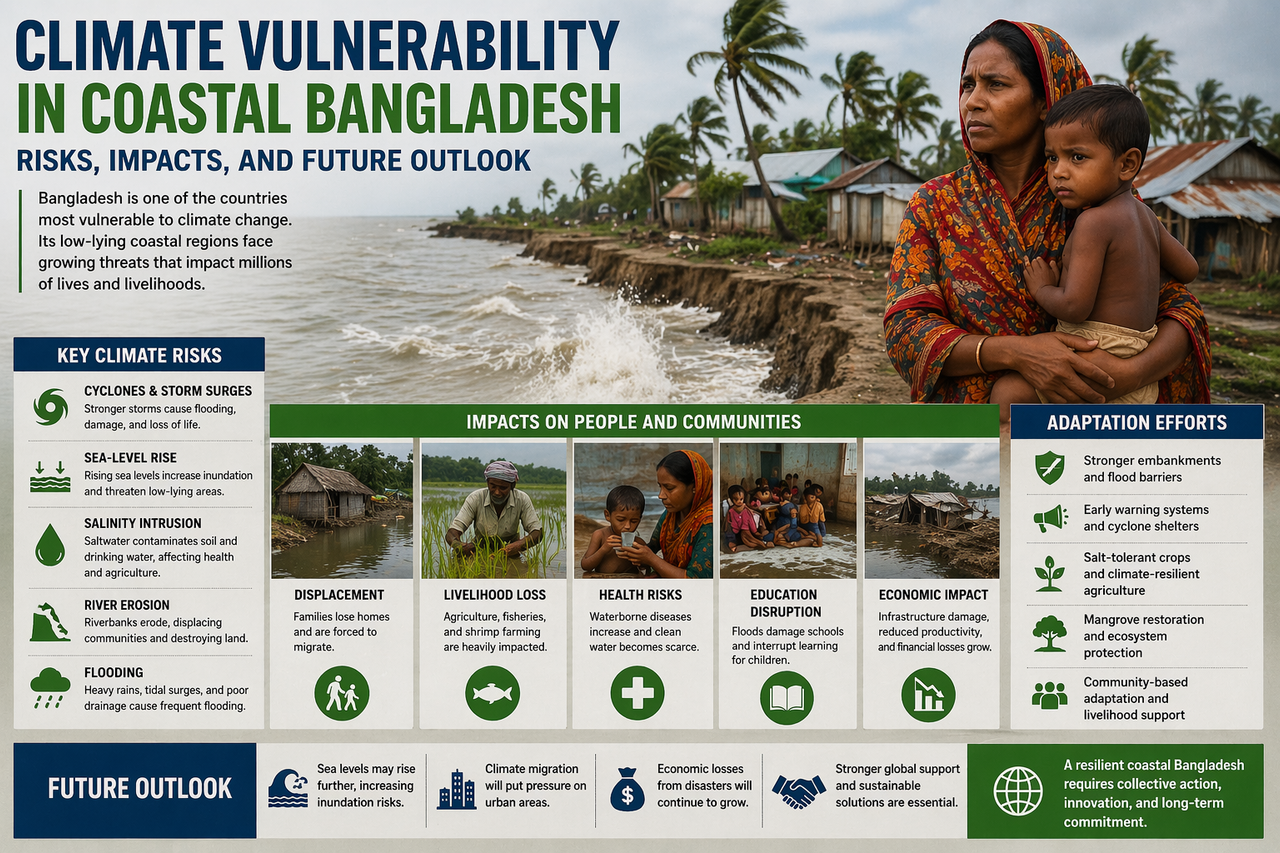
Climate vulnerability here is not just a statistic or projection. It is visible in flooded homes, in farmland turned saline, and in families quietly relocating after losing everything to erosion or storms. In coastal regions bordering the Bay of Bengal, climate change is not a future scenario—it is a lived experience.
What makes Bangladesh unique is not only its vulnerability, but also its resilience. The country has repeatedly demonstrated its ability to adapt, often with limited resources. However, the scale and speed of climate change are now testing those limits.
In this article, I will explore the risks facing coastal Bangladesh, assess current responses, and share a grounded perspective on what the future may realistically look like.
Understanding the Geography: Why Coastal Bangladesh Is So Exposed
To understand climate vulnerability, we first need to understand geography.
Bangladesh sits on one of the largest river deltas in the world, formed by the Ganges, Brahmaputra, and Meghna river systems. This creates fertile land—but also extreme exposure to water-related hazards.
The coastal belt, stretching over 700 kilometers, is characterized by:
- Low elevation (often just a few meters above sea level)
- Tidal rivers and estuaries
- Soft, erosion-prone soil
- Dense population clusters
From my perspective, the geography itself is both a blessing and a long-term risk. It enables agriculture and livelihoods, but it also ensures that even small environmental changes have outsized consequences.
The Expanding Climate Threat Landscape
Climate change is not a single threat—it is a combination of interconnected pressures.
Cyclones: More Intense, Less Predictable
Cyclones have always been part of life in Bangladesh. But their intensity and unpredictability appear to be increasing.
Storm surges push seawater deep into inland areas, destroying crops and contaminating water sources. While early warning systems have improved survival rates, the economic and environmental damage remains severe.
In my view, Bangladesh has made remarkable progress in saving lives—but not yet in protecting livelihoods.
Sea-Level Rise: The Slow but Relentless Threat
Sea-level rise is perhaps the most underestimated danger.
Unlike cyclones, it does not arrive suddenly. Instead, it gradually changes the landscape:
- Increasing permanent waterlogging
- Expanding saline zones
- Reducing usable agricultural land
This slow transformation is harder to address politically because it lacks urgency in the short term—but its long-term impact may be far greater.
Salinity Intrusion: A Silent Crisis
One of the most significant yet under-discussed issues is salinity.
Saltwater intrusion affects:
- Drinking water quality
- Crop productivity
- Human health (especially for women)
In many coastal areas, freshwater is no longer easily accessible. People rely on rainwater harvesting or travel long distances for safe water.
From my perspective, salinity is not just an environmental issue—it is a daily human challenge that deserves far more attention in policy discussions.
Riverbank Erosion: The Invisible Displacement Driver
Riverbank erosion quietly displaces thousands of families every year.
Unlike cyclones, erosion does not make global headlines. But for those affected, it is just as devastating.
Homes collapse into rivers. Land disappears permanently. Families relocate—often multiple times.
This creates a form of “invisible migration” that is rarely captured in official statistics.
Human Impact: Beyond Numbers and Statistics
Climate vulnerability is often discussed in numbers—millions affected, billions in damage. But numbers do not fully capture the human experience.
Displacement and Migration
Climate migration is becoming a defining issue.
People move:
- From coastal villages to cities
- From rural areas to informal settlements
- From unstable regions to already crowded urban centers
Cities like Dhaka are absorbing this population increase, often without adequate infrastructure.
In my view, Bangladesh is already experiencing climate migration—not in the future, but right now.
Livelihood Loss and Economic Insecurity
Coastal livelihoods depend heavily on natural systems:
- Farming
- Fishing
- Shrimp cultivation
When those systems are disrupted, income disappears.
What concerns me is the lack of diversification in many coastal economies. Without alternative income sources, communities remain highly vulnerable to repeated shocks.
Health and Social Vulnerability
Climate impacts also affect health:
- Waterborne diseases increase after floods
- Salinity affects maternal health
- Heat stress is rising
Women and children are often the most vulnerable due to social and economic inequalities.
This is not just a climate issue—it is a public health issue.
Economic Consequences: A Growing National Challenge
Climate vulnerability has macroeconomic implications.
Agricultural Decline
Salinity and flooding reduce productivity, threatening food security.
Infrastructure Damage
Cyclones and floods repeatedly damage:
- Roads
- Bridges
- Homes
- Embankments
Rebuilding costs accumulate over time.
Pressure on Government Resources
The government must continuously invest in disaster response and recovery, which limits spending in other areas like education and development.
From my perspective, climate change is not just an environmental issue for Bangladesh—it is a long-term economic challenge.
Adaptation Efforts: What Bangladesh Is Doing Right
Bangladesh is often recognized globally for its climate adaptation strategies.
Cyclone Preparedness
Early warning systems and shelters have significantly reduced fatalities.
This is one of Bangladesh’s greatest success stories.
Coastal Embankments
Infrastructure projects aim to protect low-lying areas from flooding.
However, maintenance and long-term effectiveness remain challenges.
Climate-Resilient Agriculture
Farmers are adopting salt-tolerant crops and new techniques.
This is promising—but scaling these solutions remains a challenge.
Mangrove Protection
The Sundarbans acts as a natural barrier.
Protecting it is essential—not optional.
Community Adaptation
Local initiatives show innovation and resilience:
- Raised homes
- Rainwater storage
- Livelihood diversification
In my view, these grassroots solutions are among the most effective—but they need more support.
Where Challenges Still Exist
Despite progress, several gaps remain:
- Limited long-term planning for sea-level rise
- Insufficient urban planning for climate migrants
- Funding constraints for large-scale adaptation
- Weak coordination between agencies
One key issue, in my opinion, is that adaptation efforts often focus on short-term survival rather than long-term transformation.
Climate Justice: A Global Responsibility
Bangladesh contributes very little to global emissions but faces severe consequences.
This raises important questions:
- Who should pay for adaptation?
- How should global climate funds be distributed?
- What responsibilities do developed nations have?
Organizations like the World Bank and global climate funds play a role, but more support is needed.
From my perspective, climate change in Bangladesh is not just a national issue—it is a global responsibility.
The Future: Risk vs. Resilience
Looking ahead, the future of coastal Bangladesh will likely be shaped by two competing forces:
Rising Risks
- Sea-level rise
- Extreme weather
- Population pressure
Growing Resilience
- Improved technology
- Better planning
- International cooperation
The outcome will depend on how effectively these forces are managed.
My Perspective: What Needs to Change
Based on this analysis, I believe several priorities are critical:
1. Shift From Reaction to Prevention
More investment in long-term planning rather than repeated recovery.
2. Strengthen Local Communities
Empower local solutions rather than relying only on top-down policies.
3. Plan for Migration
Recognize climate migration as inevitable and prepare accordingly.
4. Increase Global Support
Climate finance must be accessible, transparent, and sufficient.
5. Integrate Climate Into Development
Climate resilience should be part of all national planning—not a separate issue.
Conclusion: A Test of Global and National Will
Coastal Bangladesh represents one of the clearest examples of how climate change affects real lives.
It is a place where environmental change, economic pressure, and human resilience intersect every day.
The country has already shown that adaptation is possible. But the scale of future challenges will require stronger action, deeper cooperation, and sustained commitment.
In my view, the story of coastal Bangladesh is not just about vulnerability—it is about whether the world can respond effectively to one of the greatest challenges of our time.
You can read more:
-Environmental Refugees and Global Migration Trends: Climate Change and Human Displacement
-Global Climate Change in 2026: Major Environmental Challenges and Solutions
-Regional Climate Cooperation Efforts Expand as Countries Unite Against Climate Change
-Global Food Security Crisis in 2026: Rising Costs, Climate Change, and the Future of Agriculture
-Global Food Shortages Linked to Climate Change: Causes, Impacts & Long-Term Solutions



Comments
Post a Comment