Global Food Security Crisis in 2026: Rising Costs, Climate Change, and the Future of Agriculture
Introduction
Food security has become one of the most pressing global challenges in 2026. Rising food prices, climate change, geopolitical conflicts, and increasing production costs are placing enormous pressure on agricultural systems worldwide. Governments, international organizations, and farmers are working to adapt to these changing conditions while ensuring that food supplies remain stable and accessible.
The global population continues to grow, increasing demand for agricultural products. At the same time, environmental challenges and economic instability are making food production more complex. Understanding the factors influencing global agriculture today is essential for addressing the food security challenges of the future. Farmers in many developing countries are already experiencing the effects of climate variability, making crop planning increasingly difficult.
Rising Agricultural Production Costs
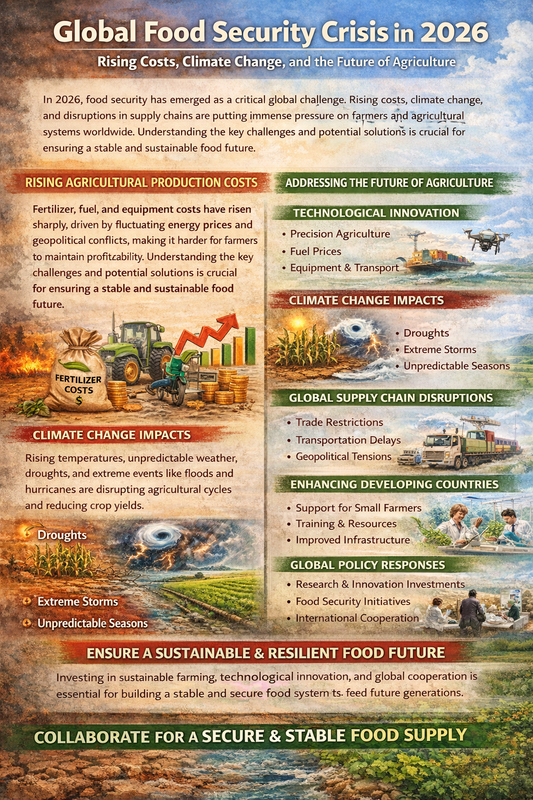
One of the biggest challenges facing farmers worldwide is the rising cost of agricultural production. Prices for fertilizers, fuel, machinery, and transportation have increased significantly in recent years.
Fertilizer prices in particular have become a major concern for farmers. Many fertilizers depend on natural gas for production, and fluctuations in global energy markets have caused sharp price increases. As a result, many farmers are struggling to maintain profitability while continuing to produce essential crops.
Higher fuel prices also increase the cost of operating tractors, irrigation systems, and transportation networks. These additional expenses eventually affect food prices in global markets, making basic food items more expensive for consumers.
Climate Change and Agricultural Uncertainty
Climate change is increasingly affecting farming systems around the world. Rising temperatures, unpredictable rainfall patterns, droughts, and floods are disrupting traditional agricultural cycles.
Farmers in many regions report that growing seasons have become less predictable. Some areas experience prolonged droughts that reduce crop yields, while others face heavy rainfall that damages crops and soil.
Extreme weather events such as hurricanes, heatwaves, and wildfires also contribute to agricultural losses. These climate-related risks make it more difficult for farmers to plan their planting and harvesting schedules.
Scientists emphasize that adapting agriculture to climate change will require improved crop varieties, better water management systems, and new farming techniques.
Global Supply Chain Disruptions
Global supply chains play an important role in ensuring that food moves efficiently from farms to consumers. However, supply chain disruptions in recent years have exposed weaknesses in global food distribution systems.
Transportation delays, trade restrictions, and geopolitical conflicts can affect the availability of agricultural products in international markets. When supply chains are disrupted, food shortages and price spikes can occur in vulnerable regions.
Countries that rely heavily on food imports are particularly sensitive to these disruptions. Governments are increasingly focusing on strengthening domestic food production and diversifying supply sources to reduce dependency on global supply chains.
Technological Innovation in Modern Agriculture
Despite these challenges, technological innovation is helping farmers improve productivity and sustainability. Modern agricultural technologies are transforming the way food is produced around the world.
Precision agriculture uses digital tools such as satellite imaging, sensors, and data analytics to monitor crop conditions and optimize farming practices. These technologies allow farmers to apply fertilizers, pesticides, and water more efficiently.
Drones are also being used to monitor crop health, detect diseases, and assess soil conditions. Artificial intelligence systems can analyze large amounts of agricultural data and provide recommendations for improving crop yields.
These innovations are helping farmers adapt to changing environmental conditions while increasing efficiency and reducing resource waste.
The Role of Sustainable Farming Practices
Sustainable farming practices are becoming increasingly important as the world seeks to balance food production with environmental protection.
Techniques such as crop rotation, organic farming, soil conservation, and water-efficient irrigation systems help maintain long-term agricultural productivity while minimizing environmental damage.
Many governments and international organizations are promoting sustainable agriculture through financial incentives, research programs, and education initiatives.
These efforts aim to ensure that agricultural systems remain productive while preserving natural ecosystems for future generations.
Food Security in Developing Countries
Food insecurity remains a serious issue in many developing countries. Limited access to agricultural technology, infrastructure, and financial resources can make it difficult for farmers to increase productivity.
Climate change often affects developing regions more severely, especially in areas that depend heavily on rain-fed agriculture. Droughts and floods can quickly lead to food shortages and economic instability.
International development programs are working to support farmers in vulnerable regions by providing training, improved seed varieties, and access to financial services.
Strengthening local food systems is essential for improving food security and reducing poverty in developing nations.
Global Policy Responses
Governments and international organizations are implementing various policy measures to address global food security challenges.
These policies include investments in agricultural research, support for farmers, improvements in rural infrastructure, and programs aimed at reducing food waste.
International cooperation is also essential for managing food supply during global crises. Organizations such as the United Nations and international development banks work with governments to coordinate responses to food shortages and agricultural disruptions.
Long-term strategies focus on increasing resilience in agricultural systems while ensuring that food remains accessible and affordable for all populations.
The Future of Global Agriculture
The future of global agriculture will likely depend on the ability of societies to adapt to changing environmental and economic conditions.
Technological innovation, sustainable farming practices, and improved global cooperation will play critical roles in shaping agricultural development over the coming decades.
Investments in agricultural research, climate-resilient crops, and digital farming technologies may help farmers overcome many of the challenges they currently face.
However, addressing food security will also require coordinated action from governments, private companies, and international organizations.
Conclusion
Global food security remains a major concern in 2026 as rising costs, climate change, and supply chain disruptions place pressure on agricultural systems. Farmers around the world are facing increasingly complex challenges while attempting to meet the growing demand for food.
At the same time, technological innovation and sustainable farming practices offer promising solutions for improving agricultural productivity and resilience.
Ensuring a stable global food supply will require continued investment in agricultural research, stronger international cooperation, and policies that support both farmers and consumers.
By addressing these challenges collectively, the global community can work toward a more secure and sustainable food future for generations to come.
You can read more:
-Russia vs United States Agricultural Innovation: Technology, Exports and Global Food Power
-Sustainable Agriculture and the Future of Food: How Farming Innovation Can Feed the World



Comments
Post a Comment