Environmental Refugees and Global Migration Trends: Climate Change and Human Displacement
Introduction
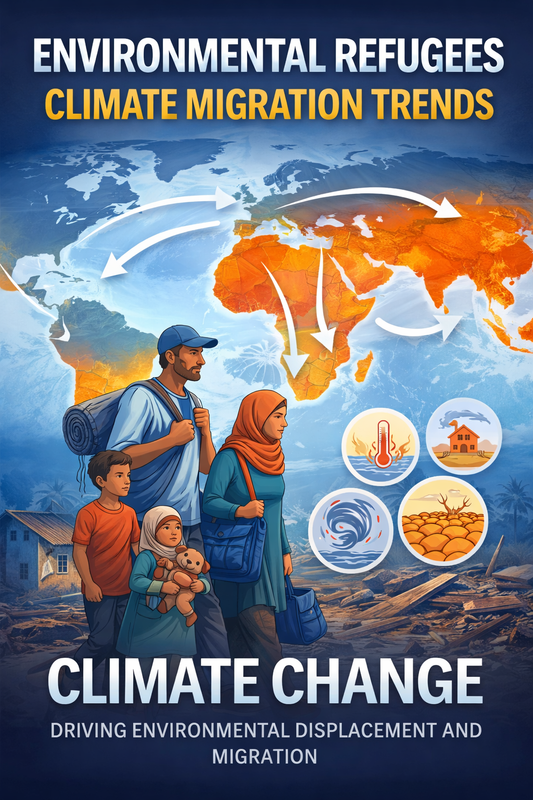
Environmental change is increasingly shaping global migration patterns. Rising sea levels, severe storms, prolonged droughts, and land degradation are forcing millions of people to leave their homes in search of safer environments and better livelihoods. These displaced populations are often referred to as environmental refugees or climate migrants.
While migration has always been part of human history, the scale and nature of environmental migration are becoming more significant in the 21st century. Scientists and policymakers warn that climate change could dramatically increase population displacement in the coming decades. According to research supported by the World Bank, climate-related factors could force more than 200 million people to migrate internally by 2050 if effective mitigation and adaptation measures are not implemented.
Understanding environmental refugees and global migration trends is essential for developing policies that address both humanitarian challenges and sustainable development. So, the environmental change can be identified as a key factor for the upcoming times.
Understanding Environmental Refugees
Environmental refugees are individuals or communities forced to relocate due to environmental changes that threaten their safety, livelihoods, or access to basic resources. These environmental disruptions can be sudden, such as hurricanes and floods, or gradual, such as desertification and rising sea levels.
Environmental displacement is often caused by:
-Sea-level rise affecting coastal areas
-Extreme weather events such as cyclones and hurricanes
-Drought and water scarcity damaging agriculture
-Land degradation and desertification
-Loss of biodiversity and ecosystems
Organizations like the International Organization for Migration describe environmental migrants as people who move primarily because environmental changes negatively impact their lives and living conditions.
Although the term “environmental refugee” is widely used in public discussions, it does not yet have a formal legal definition in international law.
Climate Change as a Major Driver of Migration
Climate change has intensified many environmental factors that contribute to migration. Rising global temperatures affect rainfall patterns, increase the frequency of extreme weather events, and accelerate sea-level rise.
According to the United Nations, climate change is one of the most significant long-term drivers of human mobility. Environmental pressures can undermine livelihoods, especially in regions that depend heavily on agriculture and natural resources.
For example:
-Farmers facing repeated crop failures may migrate to cities for employment.
-Coastal communities threatened by flooding may relocate inland.
-Regions affected by prolonged drought may experience mass population movements.
Climate-related migration is expected to increase as environmental conditions worsen.
Vulnerable Regions and Countries
Certain regions of the world are more vulnerable to environmental displacement due to geographic and socioeconomic factors.
South Asia
South Asia faces significant risks from flooding, cyclones, and rising sea levels. Low-lying countries such as Bangladesh are particularly vulnerable. Coastal erosion and salinity intrusion threaten agriculture and drinking water supplies, forcing many families to migrate to urban areas.
Sub-Saharan Africa
Many African countries are experiencing severe droughts and desertification. In regions where agriculture is the primary source of income, environmental degradation can quickly lead to food insecurity and migration.
Small Island Nations
Island countries in the Pacific and Caribbean face the existential threat of rising sea levels. Some communities may eventually be forced to relocate entirely.
Global Migration Trends
Environmental factors influence migration in several ways. These trends are becoming increasingly visible around the world.
Rural-to-Urban Migration
One of the most common forms of environmental migration is rural-to-urban movement. When environmental conditions reduce agricultural productivity, people often move to cities seeking employment and better living conditions.
Urban migration can place pressure on housing, infrastructure, and public services, particularly in rapidly growing cities.
Internal Displacement
Most environmental migrants move within their own countries rather than crossing international borders. This type of movement is known as internal displacement.
The United Nations High Commissioner for Refugees reports that environmental disasters such as floods and storms are major causes of internal displacement worldwide.
Cross-Border Migration
In some cases, environmental pressures force people to migrate to neighboring countries. However, cross-border environmental migration raises complex legal and political questions because international refugee law does not yet fully recognize environmental causes of displacement.
Social and Economic Impacts
Environmental migration has significant social and economic consequences for both migrants and host communities.
Challenges Faced by Migrants
Migrants often face numerous difficulties when relocating, including:
-Loss of homes and property
-Limited job opportunities
-Cultural and social integration challenges
-Lack of access to healthcare and education
These challenges can create long-term economic instability and social vulnerability.
Impacts on Host Communities
Host communities may experience increased pressure on:
-housing and infrastructure
-employment markets
-healthcare systems
-public services
However, migration can also contribute positively to economic development by expanding labor markets and fostering cultural exchange.
Policy Challenges and Legal Gaps
One of the major challenges associated with environmental migration is the lack of clear international legal protection for environmental refugees.
Existing frameworks such as the 1951 Refugee Convention focus primarily on persecution based on race, religion, nationality, or political opinion. Environmental factors are not explicitly included.
As a result, many climate migrants fall outside the traditional refugee protection system. Policymakers and international organizations are increasingly discussing the need for updated legal frameworks to address climate displacement.
Strategies to Address Environmental Migration
Addressing environmental migration requires coordinated action at national and international levels.
Climate Adaptation
Investing in climate adaptation can help communities remain in their homes. Examples include:
-improved flood defenses
-drought-resistant crops
-sustainable water management
Disaster Risk Reduction
Building resilient infrastructure and early warning systems can reduce the impact of environmental disasters and prevent forced displacement.
Sustainable Development
Sustainable economic development can strengthen communities' ability to adapt to environmental challenges.
International Cooperation
Global cooperation is essential to address environmental migration. Governments, international organizations, and development agencies must work together to develop policies that support displaced populations while addressing the root causes of climate-related migration.
The Future of Environmental Migration
Experts predict that environmental migration will become more common in the coming decades. Climate change, population growth, and environmental degradation are expected to increase pressure on vulnerable communities.
At the same time, technological innovation, sustainable agriculture, and climate adaptation strategies offer opportunities to reduce displacement and improve resilience.
Understanding migration patterns and investing in proactive policies can help governments manage future challenges more effectively.
Conclusion
Environmental refugees represent one of the most pressing humanitarian issues of the modern era. Climate change and environmental degradation are reshaping global migration patterns and forcing millions of people to relocate.
Addressing this challenge requires comprehensive policies that combine climate action, sustainable development, and humanitarian protection. By investing in resilience and international cooperation, the global community can better support those affected by environmental displacement while working to reduce the underlying causes of forced migration.
You can read more:
-Global Climate Change in 2026: Major Environmental Challenges and Solutions
-Regional Climate Cooperation Efforts Expand as Countries Unite Against Climate Change
-Global Food Security Crisis in 2026: Rising Costs, Climate Change, and the Future of Agriculture
-Climate Vulnerability in Coastal Bangladesh: Risks, Impacts & Future Outlook



Comments
Post a Comment