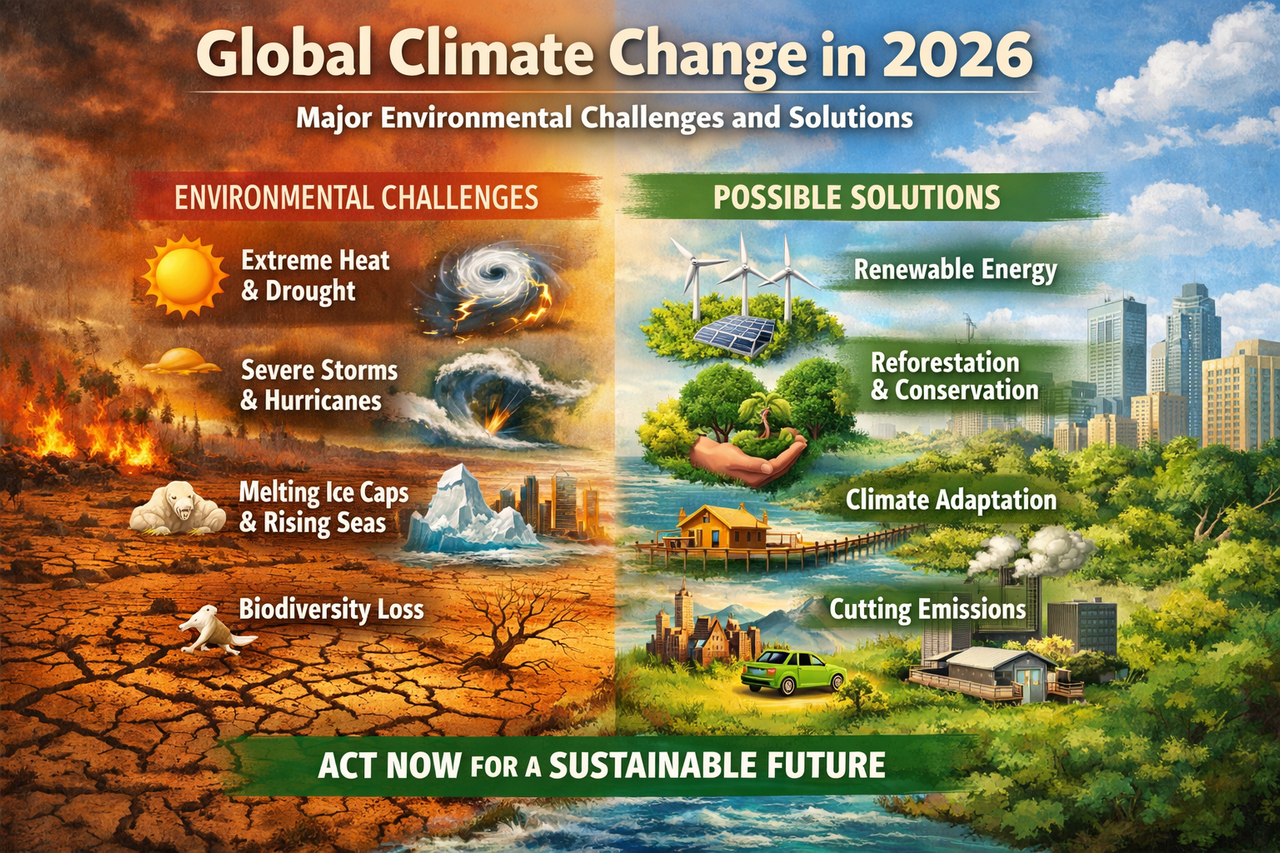
Global Climate Change in 2026: Major Environmental Challenges and Solutions
Climate change remains one of the most critical global challenges facing humanity in 2026. Rising temperatures, extreme weather events, melting glaciers, and environmental disruptions are affecting countries across the world. Scientists warn that without significant action, climate change could have long-lasting consequences for ecosystems, economies, and human societies.
Governments, environmental organizations, and researchers are increasingly focusing on sustainable solutions to reduce greenhouse gas emissions and protect the planet’s natural resources.
Understanding the current climate situation and the efforts being made to address it is essential for shaping a more sustainable future.
Rising Global Temperatures
Over the past several decades, global temperatures have steadily increased due to the accumulation of greenhouse gases in the atmosphere. Carbon dioxide, methane, and other emissions from human activities such as industrial production, transportation, and energy generation contribute significantly to global warming.
In 2026, climate monitoring organizations continue to report that many regions are experiencing record-breaking temperatures. Heatwaves have become more frequent and intense, affecting millions of people across continents.
These temperature increases can lead to several environmental consequences, including droughts, wildfires, and changes in natural ecosystems.
For many communities, especially those in vulnerable regions, rising temperatures also pose serious health and economic challenges.
Extreme Weather Events Increasing
Another major consequence of climate change is the growing number of extreme weather events. Scientists have observed a rise in powerful storms, floods, hurricanes, and prolonged droughts.
These events often cause severe damage to infrastructure, agriculture, and local economies. Communities in coastal regions are particularly at risk due to rising sea levels and stronger storms.
In many parts of the world, flooding has become more frequent, forcing governments to invest heavily in disaster prevention and emergency response systems.
Extreme weather events not only threaten lives but also create long-term economic challenges that can affect national development.
Melting Ice and Rising Sea Levels
The melting of glaciers and polar ice caps is one of the most visible signs of global climate change. As temperatures increase, large ice sheets in Greenland and Antarctica continue to lose mass.
This melting contributes directly to rising sea levels, which threaten coastal cities and island nations. Some low-lying regions face the possibility of permanent flooding in the coming decades.
Countries with large coastal populations are already investing in protective infrastructure such as sea walls and flood control systems.
Scientists emphasize that reducing global emissions is essential to slow down ice melt and prevent further sea-level rise.
Impact on Agriculture and Food Security
Climate change also has a significant impact on agriculture and food production. Changing rainfall patterns, soil degradation, and temperature fluctuations can affect crop yields and farming practices.
Farmers in many regions are facing challenges as traditional growing seasons become less predictable.
In response, agricultural researchers are developing climate-resilient crops and sustainable farming techniques that can adapt to changing environmental conditions.
Technologies such as precision agriculture, satellite monitoring, and advanced irrigation systems are helping farmers improve efficiency while conserving natural resources.
Ensuring global food security in the face of climate change remains one of the most important challenges for policymakers and scientists.
Renewable Energy and Climate Solutions
Despite the challenges posed by climate change, many countries are making progress toward cleaner and more sustainable energy systems.
Renewable energy technologies such as solar power, wind energy, and hydropower are expanding rapidly worldwide. Governments and private companies are investing heavily in green infrastructure to reduce reliance on fossil fuels.
Electric vehicles, energy-efficient buildings, and smart power grids are also contributing to lower emissions in many urban areas.
These innovations demonstrate that technological solutions can play a critical role in addressing environmental challenges.
International Cooperation on Climate Policy
Climate change is a global issue that requires cooperation between nations. International agreements and climate conferences continue to play an important role in coordinating global efforts to reduce emissions.
Countries are increasingly working together to share technology, funding, and research aimed at promoting sustainable development.
Many international organizations encourage governments to adopt policies that balance economic growth with environmental protection.
Cooperation between developed and developing countries is especially important, as climate change affects regions differently depending on geography and economic resources.
The Role of Technology in Climate Monitoring
Modern technology is helping scientists better understand and track climate change. Satellites, environmental sensors, and advanced data analysis systems allow researchers to monitor changes in the atmosphere, oceans, and ecosystems.
Artificial intelligence and machine learning are also being used to analyze large environmental datasets and predict climate patterns more accurately.
These technological tools help governments and organizations make informed decisions about climate policy and environmental protection strategies.
The Importance of Public Awareness
Public awareness and education are crucial in addressing climate change. Individuals, communities, and businesses all play a role in reducing environmental impact.
Simple actions such as conserving energy, reducing waste, supporting sustainable products, and promoting environmental policies can contribute to long-term climate solutions.
Educational programs and environmental campaigns are helping raise awareness about the importance of protecting the planet for future generations.
Conclusion
Global climate change continues to present serious challenges for the international community in 2026. Rising temperatures, extreme weather events, melting ice caps, and disruptions to agriculture highlight the urgent need for coordinated action.
However, technological innovation, renewable energy development, and international cooperation offer promising opportunities to address these challenges.
By combining scientific research, responsible policy decisions, and public engagement, societies around the world can work toward a more sustainable and resilient future.
Protecting the planet is not only an environmental responsibility but also an essential step toward ensuring economic stability and human well-being for generations to come.
You can read more:
-Climate Change and Extreme Weather 2026: Global Crisis, Rising Temperatures, and Future Risks
-Plastic Pollution Crisis: Global Causes, Environmental Impacts, and Sustainable Solutions
-Air Pollution and Public Health Risks Worldwide: A Growing Global Crisis
-Why Global Temperatures Are Rising Faster Than Predicted in 2026



Comments
Post a Comment