Introduction:
Agriculture has re-emerged as one of the most critical sectors shaping global power dynamics in the 21st century. Beyond feeding populations, it influences geopolitics, trade balances, environmental sustainability, and national security. Among the world’s leading agricultural nations, Russia and the United States stand out as dominant yet contrasting forces.
Both countries possess vast land resources, advanced capabilities, and global export influence. However, their agricultural models differ significantly in terms of technology adoption, biotechnology policies, climate strategies, and economic priorities.
This in-depth comparative analysis explores how Russia and the United States are reshaping agricultural innovation and redefining global food power.
1. Scale, Resources, and Global Position
Russia: The Grain Superpower
Russia has rapidly transformed into one of the world’s most influential agricultural exporters, particularly in wheat. Over the past two decades, it has shifted from being a net importer to a dominant exporter.
Key strengths include:
-Vast arable land, especially in southern and central regions
-Expansion of agricultural zones due to warming temperatures
-Strong focus on large-scale grain production
Russia’s wheat exports play a vital role in feeding regions such as North Africa, the Middle East, and parts of Asia. Its competitive pricing and large volumes have made it a cornerstone of global grain markets.
Additionally, Russia’s agricultural policy emphasizes self-sufficiency and export strength, positioning food production as a strategic geopolitical tool.
United States: The Diversified Agricultural Giant
The United States remains one of the most productive and technologically advanced agricultural economies in the world.
Key strengths include:
-Highly diversified production (corn, soybeans, wheat, fruits, vegetables, and livestock)
-Advanced agribusiness systems
-Strong global export presence
Unlike Russia’s heavy concentration on grains, the U.S. leads in high-value agricultural products, processed foods, and agricultural services. Its exports support global food systems, particularly livestock industries that depend on American corn and soybeans.
The scale of U.S. agriculture is not only measured in output but also in innovation, efficiency, and value addition.
2. Technology and Precision Farming
Russia’s Technological Transformation
Russia has made significant progress in modernizing its agricultural sector, particularly among large agribusinesses.
Technological advancements include:
-GPS-guided machinery for efficient field operations
-Satellite-based crop monitoring systems
-Drone usage for pest detection and crop analysis
-Artificial intelligence for yield prediction
However, technological adoption is uneven. While large farming enterprises operate with modern systems, smaller farms often lack access to advanced tools due to financial and infrastructural constraints.
Despite this gap, Russia’s modernization trajectory is strong, with increasing investment in digital agriculture.
United States: Global Leader in Precision Agriculture
The United States is widely recognized as the global leader in precision farming technologies.
Key innovations include:
-Autonomous tractors and robotic harvesting systems
-AI-powered farm management platforms
-Big data analytics for predictive agriculture
-Smart irrigation and water management systems
Farmers use real-time data to optimize planting, fertilization, and harvesting decisions. This results in higher yields, reduced waste, and improved environmental sustainability.
The U.S. agricultural ecosystem also benefits from strong collaboration between private companies, universities, and government agencies, driving continuous innovation.
3. Biotechnology and Genetic Innovation
Russia’s Cautious Approach
Russia has taken a restrictive stance on genetically modified (GM) crops. Commercial cultivation of GM crops is largely prohibited.
Instead, Russia focuses on:
-Hybrid seed development
-Organic farming expansion
-Domestic seed independence
This approach aligns with national goals of food sovereignty and appeals to markets demanding non-GM products.
However, critics argue that limiting GM adoption may reduce yield potential and technological competitiveness in the long term.
United States: Biotechnology Powerhouse
The United States leads the world in agricultural biotechnology.
Key characteristics include:
-Widespread use of GM crops, especially corn and soybeans
-Strong private-sector investment in research and development
-Advanced gene-editing technologies
Biotechnology enables U.S. farmers to:
-Increase productivity
-Enhance pest resistance
-Reduce input costs
The integration of biotech with digital agriculture further strengthens the U.S. position as a global innovation leader.
4. Climate Change and Environmental Strategy
Russia: Opportunity and Risk
Climate change presents both opportunities and challenges for Russia.
Positive impacts:
-Expansion of arable land in northern regions
-Longer growing seasons
-Potential for increased production
Challenges:
-Soil degradation
-Unpredictable weather patterns
-Regional drought risks
Russia’s future agricultural growth may depend heavily on how effectively it manages these environmental changes.
United States: Adaptation Under Pressure
The United States faces more immediate climate-related challenges.
Major issues include:
-Severe droughts in western states
-Water scarcity in key farming regions
-Increased frequency of extreme weather events
In response, U.S. farmers are adopting:
-Water-efficient irrigation systems
-Climate-resilient crop varieties
-Sustainable farming practices
Government programs and insurance systems also help mitigate climate risks, ensuring stability in agricultural production.
5. Infrastructure and Export Networks
Russia: Strategic but Concentrated
Russia’s export system is heavily focused on grain logistics.
Key features:
-Dependence on Black Sea ports
-Efficient grain export terminals
-Competitive pricing strategies
However, this concentration creates vulnerability. Geopolitical tensions and logistical disruptions can significantly impact export flows.
United States: Highly Developed and Diversified
The U.S. benefits from one of the most advanced agricultural logistics networks in the world.
Key strengths:
-Extensive rail and highway systems
-River transport via major waterways
-Multiple export ports on both coasts
This diversified infrastructure allows for flexible and efficient distribution of agricultural products across global markets.
6. Government Policy and Economic Models
Russia: State-Driven Strategy
Russia treats agriculture as a strategic sector tied to national security.
Key policies include:
-State-backed financing and subsidies
-Import substitution initiatives
-Export controls during domestic shortages
Government involvement plays a central role in shaping agricultural development and ensuring food independence.
United States: Market-Driven with Public Support
The U.S. agricultural system combines private innovation with government support.
Key elements:
-Farm subsidies and crop insurance programs
-Research funding through public institutions
-Strong role of agribusiness corporations
This hybrid model fosters innovation while maintaining stability and resilience in the agricultural sector.
7. Global Food Security and Market Influence
Both Russia and the United States are critical to global food security, but their roles differ.
Russia:
-Dominates global wheat markets
-Influences staple food prices in developing regions
-Plays a key role in food supply to import-dependent countries
United States:
-Supplies essential feed crops for global livestock industries
-Leads in processed food exports
-Supports global agricultural systems through technology and innovation
Disruptions in either country—whether due to climate events, political instability, or trade conflicts—can trigger significant fluctuations in global food prices.
8. Innovation Ecosystems and Future Trends
Russia’s Path Forward
Russia is likely to focus on:
-Expanding grain production capacity
-Strengthening domestic agricultural technology
-Increasing self-reliance in seeds and inputs
Its strategy emphasizes stability, sovereignty, and export growth.
United States’ Future Direction
The U.S. will continue to lead in:
-Agricultural robotics and automation
-Biotechnology and genetic engineering
-Data-driven farming systems
Innovation will remain the cornerstone of American agricultural dominance.
9. Competition or Complementarity?
While often viewed as competitors, Russia and the United States may actually serve complementary roles in global agriculture.
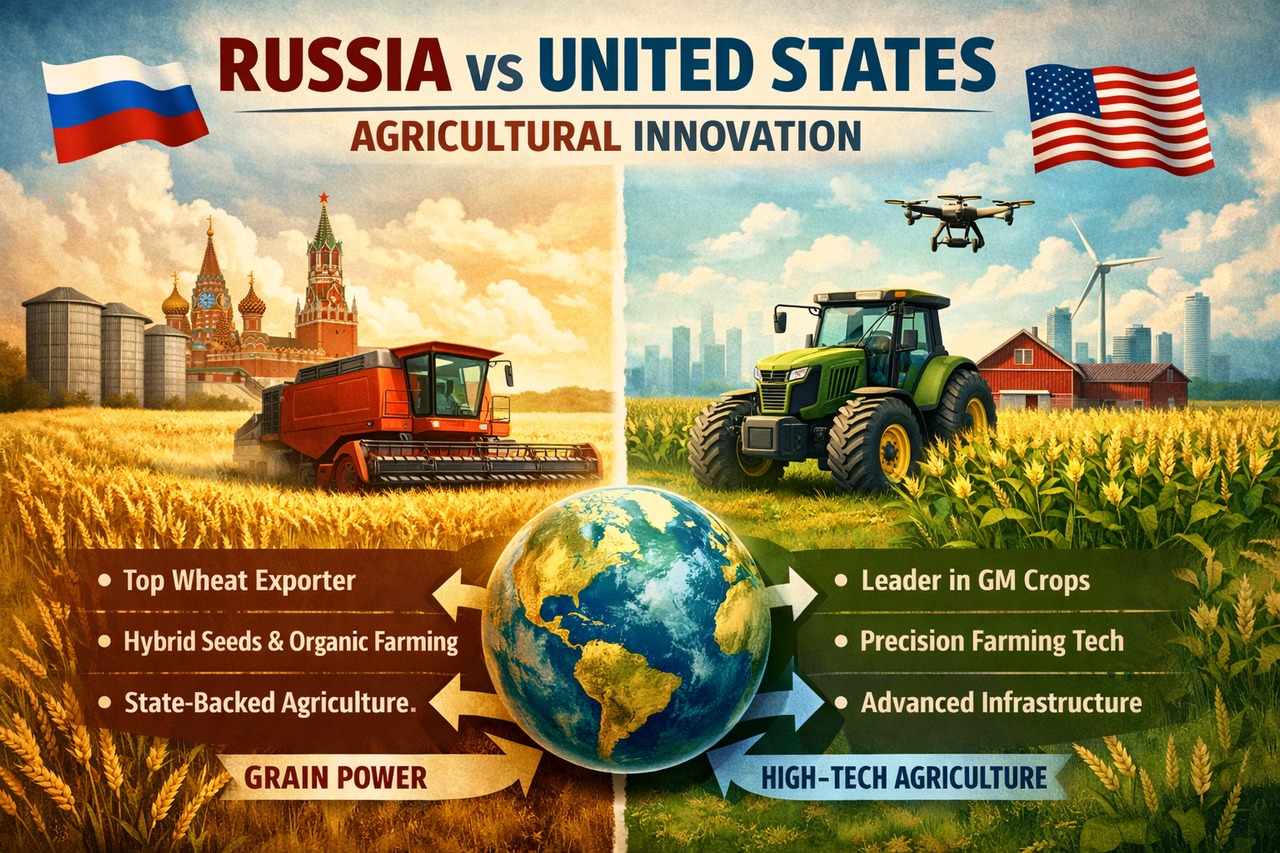
-Russia specializes in large-scale grain exports
-The United States leads in diversified, high-value, and technology-driven agriculture
Together, they contribute to balancing global food supply and demand.
Conclusion
Russia and the United States represent two distinct models of agricultural power.
Russia’s strength lies in its vast land resources, grain production, and strategic state-driven policies. It has positioned itself as a dominant force in global wheat markets and a key player in food security for many regions.
The United States, on the other hand, leads through innovation, diversification, and technological advancement. Its integration of biotechnology, precision farming, and advanced infrastructure sets the global benchmark for modern agriculture.
As the world faces increasing challenges from climate change, population growth, and geopolitical tensions, both nations will remain central to the future of global food systems.
Rather than existing in direct opposition, their differing strengths may ultimately create a more resilient and interconnected global agricultural landscape.
You can read more:
-Sustainable Agriculture and the Future of Food: How Farming Innovation Can Feed the World
-Global Food Security Crisis in 2026: Rising Costs, Climate Change, and the Future of Agriculture
-Russia’s Agricultural Innovation: Smart Farming and Global Food Power Growth
-Global Food Shortages Linked to Climate Change: Causes, Impacts & Long-Term Solutions



Comments
Post a Comment