Diplomacy Trends in a Multipolar World: Navigating Global Power in 2026
Introduction: A World No Longer Defined by One Power
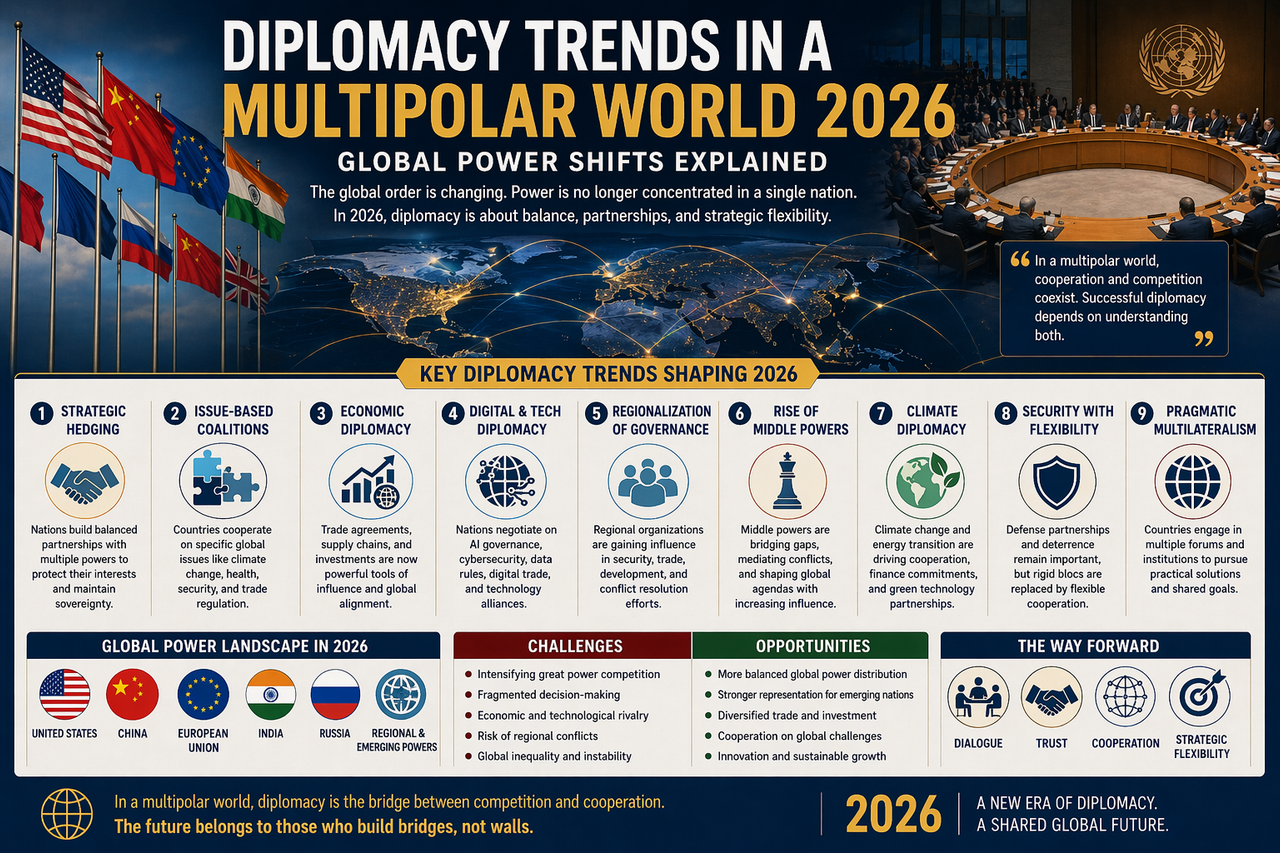
The global political landscape in 2026 is no longer dominated by a single superpower or a rigid ideological divide. Instead, it is increasingly shaped by multipolarity—a system in which influence is distributed among several major and emerging powers.
From my perspective, this transformation is not just a shift in power—it is a fundamental change in how diplomacy itself operates.
For decades, international relations revolved around predictable alliances and clearly defined blocs. Today, those structures are more fluid. Countries cooperate with one partner on trade, compete with the same partner on technology, and maintain strategic distance on security issues.
This evolving reality has made diplomacy more complex, but also more dynamic.
Understanding diplomacy in a multipolar world requires moving beyond traditional frameworks and recognizing the growing importance of flexibility, pragmatism, and strategic balance.
The Rise of Multipolarity: A Structural Shift in Global Power
The late 20th century was defined first by the bipolar rivalry between the United States and the Soviet Union, and later by a period of unipolar dominance led by the United States.
Today, global influence is more widely distributed.
Key Global Actors in 2026
- United States
- China
- European Union
- India
- Russia
Alongside them, influential regional and middle powers are playing increasingly important roles.
From my perspective, multipolarity does not automatically lead to instability. However, it does create a more competitive and less predictable environment, where no single actor can dictate outcomes unilaterally.
Trend 1: Strategic Hedging and Flexible Alliances
One of the most defining features of diplomacy in 2026 is strategic hedging.
Countries are no longer aligning themselves exclusively with one major power. Instead, they pursue diversified relationships to maximize benefits and reduce risk.
Examples of Strategic Hedging
- Southeast Asian nations maintain economic ties with China while strengthening security partnerships with the United States
- Middle Eastern states expand relations with both Western and Asian powers
- African countries engage multiple partners for infrastructure and development
From my perspective, this approach reflects a rational response to uncertainty. It allows countries to maintain sovereignty while navigating competing global interests.
However, it also introduces complexity, as overlapping partnerships can create tensions and conflicting commitments.
Trend 2: Issue-Based Coalitions Replacing Rigid Blocs
Traditional alliances based on ideology or geography are giving way to issue-based coalitions.
Countries now collaborate selectively on specific issues such as:
- Climate change
- Global health
- Cybersecurity
- Trade regulation
- Energy transition
For example, nations that compete in security matters may still cooperate on climate negotiations or pandemic response.
This reflects what I see as a key characteristic of modern diplomacy: cooperation and competition are no longer mutually exclusive.
Trend 3: Economic Diplomacy as a Strategic Tool
Economic power has become central to diplomatic influence.
Trade agreements, investment flows, and supply chains now shape geopolitical relationships as much as military alliances.
Key Developments
- Regional trade agreements expanding influence
- Supply chain diversification to reduce dependency
- Competition over critical minerals and technology components
- Currency diversification in global trade
From my perspective, economic diplomacy is now the primary battlefield of global competition.
Countries are not just negotiating trade—they are negotiating long-term economic security.
Trend 4: The Rise of Digital and Tech Diplomacy
Technology is now at the center of geopolitical competition.
Diplomacy increasingly involves:
- Artificial Intelligence governance
- Cybersecurity agreements
- Data sovereignty and privacy
- Semiconductor supply chains
- Digital currency frameworks
Digital diplomacy also includes how governments communicate globally through online platforms.
In my view, technology has become both a tool and a domain of diplomacy.
Unlike traditional diplomacy, tech diplomacy evolves rapidly, requiring constant adaptation and expertise.
Trend 5: Regionalization of Global Governance
While global institutions remain important, regional organizations are becoming more influential.
Key Regional Actors
- Association of Southeast Asian Nations
- African Union
- European Union
- Gulf Cooperation Council
- Mercosur
These organizations address region-specific challenges more effectively than global institutions in many cases.
From my perspective, regionalization reflects a practical reality: neighboring countries often share immediate interests that require collective solutions.
Trend 6: The Growing Influence of Middle Powers
Middle powers are playing a more active diplomatic role.
Countries such as:
- India
- Brazil
- Indonesia
- Turkey
- Saudi Arabia
- South Korea
are increasingly mediating conflicts and shaping international agreements.
From my perspective, middle powers act as stabilizers in a multipolar system. They provide alternative channels for dialogue and reduce reliance on major power rivalry.
Trend 7: Climate Diplomacy as a Strategic Priority
Climate change is no longer just an environmental issue—it is a geopolitical priority.
Countries are negotiating:
- Emissions reduction targets
- Climate finance agreements
- Renewable energy partnerships
- Access to green technology
Climate diplomacy influences trade, investment, and global alliances.
From my perspective, climate policy is becoming a defining factor in international relations.
Trend 8: Security Without Rigid Bloc Confrontation
While military alliances still matter, there is a noticeable shift away from rigid bloc confrontation.
Security diplomacy now includes:
- Joint military exercises
- Maritime cooperation
- Intelligence sharing
- Arms control discussions
Even rival nations maintain diplomatic channels to avoid escalation.
In my view, this reflects a shared understanding that large-scale conflict would have global consequences.
Trend 9: Pragmatic Multilateralism
Multilateralism is evolving rather than disappearing.
Countries are participating in multiple forums, including:
- G20
- Climate summits
- Regional economic platforms
- Development institutions
From my perspective, this flexible approach allows countries to pursue specific goals without being constrained by rigid alliances.
Challenges in a Multipolar Diplomatic System
Multipolarity introduces several challenges:
- Increased competition among major powers
- Fragmented decision-making
- Overlapping alliances
- Risk of regional conflicts
- Economic fragmentation
In my view, the biggest challenge is managing complexity.
Diplomacy must now balance multiple relationships simultaneously, requiring higher levels of coordination and strategic thinking.
Opportunities in a Multipolar World
Despite challenges, multipolarity offers advantages:
- Greater representation for emerging economies
- More balanced global power distribution
- Increased diplomatic flexibility
- Diverse economic partnerships
From my perspective, multipolarity creates a more inclusive international system—if managed effectively.
The Future of Diplomacy: What Comes Next
Looking ahead, diplomacy is likely to focus on:
- Resilience rather than dominance
- Cooperation on shared global challenges
- Technological governance
- Sustainable development
- Strategic flexibility
The future will not be defined by a single dominant power, but by how effectively countries navigate complexity.
My Perspective: Adapting to a Multipolar Reality
In my view, successful diplomacy in 2026 requires:
1. Flexibility
Rigid strategies are no longer effective.
2. Balance
Countries must manage relationships with multiple partners.
3. Long-Term Thinking
Short-term gains must be balanced with long-term stability.
4. Investment in Diplomacy
Skilled diplomacy is more important than ever.
Conclusion: A New Era of Global Engagement
Diplomacy in a multipolar world reflects a fundamental transformation in international relations.
Power is more distributed, alliances are more flexible, and global challenges require collective action.
From my perspective, this new era is not inherently unstable—but it demands smarter, more adaptive diplomacy.
The countries that succeed will be those that embrace complexity, invest in relationships, and navigate global power with strategic clarity.
You can read more:
-Global Diplomatic Maneuvers Intensify in 2026: Trade Tensions, Tech Regulation & the Reshaping of World Order
-Global Peace Efforts in 2026: Diplomacy, Ceasefires & International Cooperation
-International Cooperation for Global Peace and Stability in a Changing World
-World War and Peace: Causes, Consequences, and the Path Toward Global Stability

Comments
Post a Comment