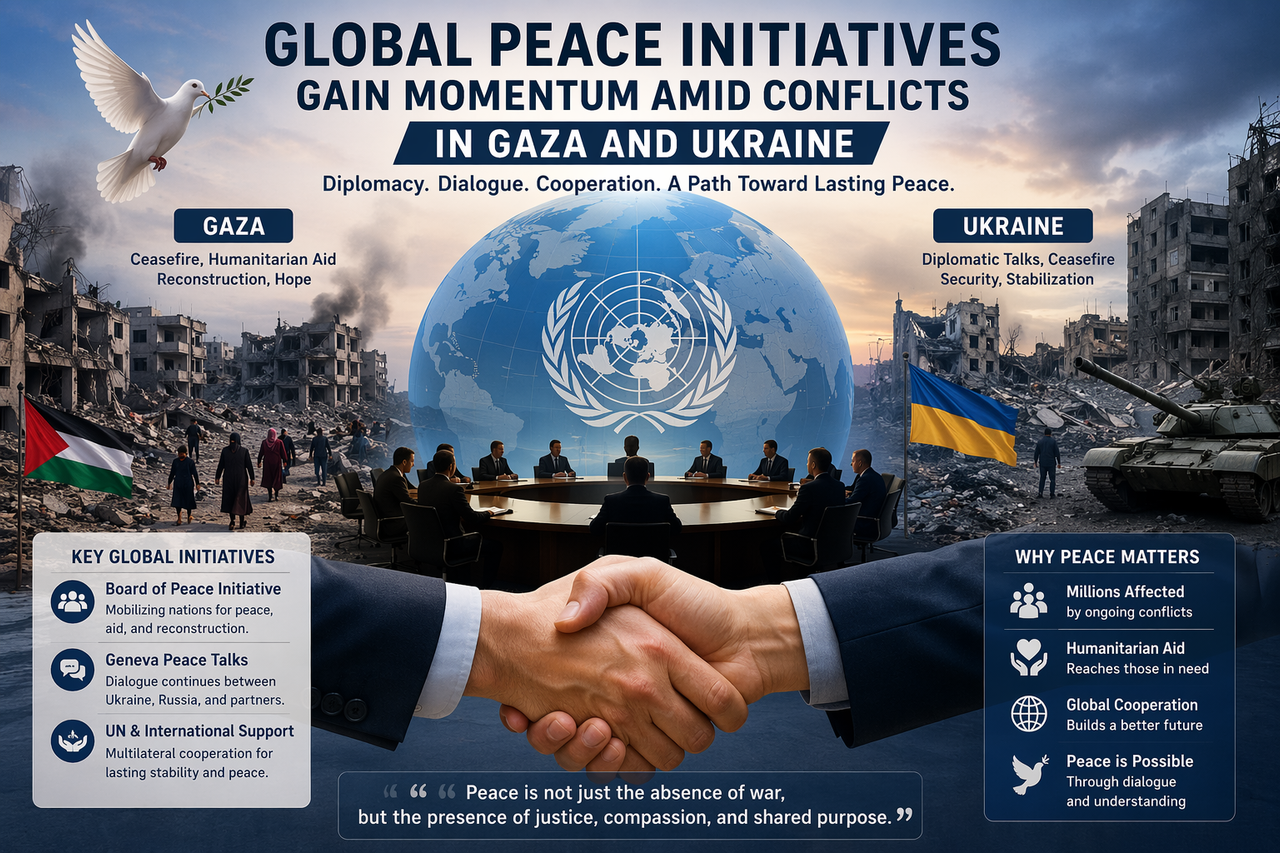
Global Peace Initiatives Gain Momentum Amid Conflicts in Gaza and Ukraine
In an era defined by geopolitical fragmentation, prolonged warfare, and humanitarian crises, global peace initiatives have re-emerged as a central focus of international diplomacy. As conflicts in the Middle East and Eastern Europe continue to shape global politics, new frameworks, diplomatic experiments, and multilateral efforts are attempting to chart a path toward stability.
From the launch of new diplomatic bodies at high-profile global forums to renewed negotiations in long-standing conflicts, 2026 has become a pivotal year for peacebuilding. While optimism remains cautious, the convergence of initiatives signals a renewed willingness among global actors to explore pathways beyond prolonged conflict.
This article explores key peace efforts surrounding Gaza and Ukraine, analyzes broader diplomatic trends, and offers a grounded perspective on what these developments mean for the future of global stability.
1. The “Board of Peace” Initiative: A New Diplomatic Experiment
One of the most notable developments in global peacebuilding came in January 2026, when former U.S. President Donald Trump introduced the “Board of Peace” during the annual World Economic Forum held in Davos.
Concept and Objectives
The Board of Peace was envisioned as a flexible, action-oriented diplomatic platform aimed at accelerating peace efforts, particularly in conflict zones like Gaza. Unlike traditional multilateral institutions, the Board seeks to:
- Coordinate rapid humanitarian responses
- Mobilize reconstruction funding
- Facilitate direct diplomatic engagement
- Encourage political dialogue outside rigid frameworks
The initiative reflects a broader trend toward alternative diplomacy, where coalitions of willing nations attempt to bypass bureaucratic inertia often associated with traditional organizations.
From my perspective, the creation of such a body highlights both innovation and frustration. On one hand, it shows a desire to act quickly in crises. On the other, it implicitly signals dissatisfaction with existing institutions.
Mixed Global Reactions
The international response to the Board of Peace has been notably divided:
Supporters include:
- Several Arab and Muslim-majority countries
- Nations seeking faster humanitarian coordination
- States interested in diversifying diplomatic platforms
Skeptics include:
- European allies emphasizing institutional continuity
- Religious and moral authorities like the Holy See
- Countries concerned about political motivations and legitimacy
The Vatican’s decision not to participate is particularly significant. It emphasized that peace efforts should remain anchored in universally recognized frameworks such as the United Nations, reinforcing the importance of legitimacy in global diplomacy.
Washington Follow-Up Meeting
A subsequent meeting held in Washington brought together representatives from over two dozen countries. The agenda focused on:
- Gaza reconstruction financing
- Infrastructure rehabilitation
- Governance models for post-conflict stability
However, the absence of key Western allies raised questions about the Board’s long-term influence.
Analytical Insight
In my view, the Board of Peace represents a parallel diplomacy model—not necessarily a replacement for traditional institutions but an attempt to complement them. Its success will depend heavily on:
- Inclusivity
- Transparency
- Measurable outcomes
Without these, it risks being perceived as politically driven rather than genuinely humanitarian.
2. Gaza Conflict: From Crisis to Conditional Stabilization
The conflict in Gaza remains one of the most complex and emotionally charged geopolitical issues. Years of violence have left deep humanitarian scars and structural devastation.
UN-Led Peace Framework
In October 2025, the United Nations Security Council adopted Resolution 2803, establishing a comprehensive peace plan for Gaza.
Key elements include:
- A phased ceasefire agreement
- Release of hostages
- Deployment of international stabilization forces
- Reconstruction funding mechanisms
- Governance transition frameworks
This plan marked one of the most structured international responses to the Gaza crisis in recent years.
Humanitarian Data Snapshot
- The scale of destruction in Gaza underscores the urgency of peace efforts:
- Tens of thousands of casualties reported over multiple escalation cycles
- Infrastructure damage affecting hospitals, schools, and utilities
- Millions requiring humanitarian assistance
- Severe disruptions to water, electricity, and food supply systems
While exact numbers fluctuate, international agencies consistently describe the situation as a humanitarian emergency of global concern.
Reconstruction Challenges
Rebuilding Gaza presents multiple challenges:
Continued instability complicates reconstruction efforts.
Competing governance claims hinder unified administration.
Billions of dollars are required for infrastructure restoration.
Years of conflict have eroded trust between stakeholders.
Global Responses
Countries have responded differently:
- Some strongly support the UN-led framework
- Others advocate broader negotiations involving regional actors
- A few remain cautious due to political sensitivities
India, for example, welcomed the initial phase of the plan, emphasizing humanitarian access and peaceful dialogue.
Personal Perspective
From a neutral standpoint, Gaza illustrates a critical reality: peace is not just about stopping violence—it is about building sustainable systems afterward. Without long-term governance solutions, ceasefires risk becoming temporary pauses rather than lasting resolutions.
3. Ukraine Conflict: Diplomacy Amid Prolonged War
The war between Ukraine and Russia has now extended into its fifth year, making it one of the most significant geopolitical conflicts of the 21st century.
Geneva Peace Talks
In March 2026, negotiations resumed in Geneva, a city historically associated with diplomacy.
Participants included:
- Ukrainian officials
- Russian representatives
- U.S. envoys
Volodymyr Zelenskyy reaffirmed Ukraine’s commitment to diplomacy, even as military engagements continued.
Meanwhile, the Kremlin signaled openness to negotiations, though key disagreements remain unresolved.
Core Issues in Negotiations
The talks revolve around several contentious topics:
- Territorial sovereignty
- Security guarantees
- NATO alignment concerns
- Economic sanctions
- War reparations
These issues highlight the complexity of modern warfare, where political, military, and economic dimensions are deeply intertwined.
Economic Impact of the War
The Ukraine conflict has had far-reaching global consequences:
- Disruptions in energy markets
- Food supply instability due to grain export interruptions
- Inflationary pressures worldwide
- Increased defense spending across Europe
According to global economic estimates, the war has cost hundreds of billions of dollars in damages and economic losses.
Europe’s Role
European nations have taken a dual approach:
- Providing military and financial support to Ukraine
- Encouraging diplomatic solutions
This balancing act reflects a broader dilemma: how to pursue peace without compromising security principles.
Analytical Perspective
In my view, the Ukraine conflict demonstrates that modern wars are rarely resolved quickly. Instead, they evolve into prolonged geopolitical standoffs where diplomacy becomes a gradual, iterative process rather than a single breakthrough moment.
4. The Role of Multilateral Institutions in Peacebuilding
Despite new initiatives like the Board of Peace, traditional institutions continue to play a central role.
United Nations
The United Nations remains the primary platform for:
- Conflict mediation
- Peacekeeping operations
- Humanitarian coordination
Its legitimacy stems from broad international participation, even though it often faces criticism for inefficiency.
Regional Organizations
Other organizations also contribute significantly:
- European Union (financial and political support)
- Regional alliances in the Middle East
- International financial institutions
These bodies help implement peace agreements and fund reconstruction efforts.
Strengths and Limitations
Strengths:
- Global legitimacy
- Established frameworks
- Experience in conflict resolution
Limitations:
- Slow decision-making
- Political disagreements among member states
- Limited enforcement power
- Personal Reflection
From a neutral standpoint, multilateral institutions are indispensable but imperfect. They provide structure and legitimacy but often struggle with speed and decisiveness.
5. Emerging Trends in Global Peacebuilding
Several broader trends are shaping peace initiatives in 2026:
1. Multipolar Diplomacy
The world is increasingly multipolar, with multiple powers influencing global decisions. This leads to:
- More negotiation channels
- Competing diplomatic approaches
- Greater complexity in consensus-building
2. Hybrid Peace Models
Peace efforts now combine:
- Traditional diplomacy
- Economic incentives
- Humanitarian interventions
- Technological monitoring systems
3. Increased Role of Non-State Actors
NGOs, private organizations, and think tanks are playing larger roles in:
- Mediation
- Policy development
- Humanitarian aid delivery
4. Focus on Reconstruction
Modern peace efforts emphasize not just ending conflict but rebuilding societies, including:
- Infrastructure
- Governance systems
- Economic stability
5. Data-Driven Decision Making
Advanced analytics and real-time data are increasingly used to:
- Monitor ceasefires
- Track humanitarian needs
- Improve policy outcomes
6. Balancing Peace, Justice, and Sovereignty
One of the most challenging aspects of peacebuilding is balancing competing priorities:
Peace vs. Justice
Should peace agreements include accountability for past actions?
Or should they prioritize immediate stability?
Sovereignty vs. Intervention
When should international actors intervene?
How can sovereignty be respected while protecting civilians?
Security vs. Diplomacy
How much military strength is necessary to ensure peace?
When should negotiations take precedence?
Personal Insight
In my view, sustainable peace requires a balanced approach. Overemphasizing any single factor—whether justice, sovereignty, or security—can undermine long-term stability.
7. What Lies Ahead for Global Peace Efforts?
Looking forward, several developments will shape the trajectory of peace initiatives:
Expansion of the Board of Peace
The Board may:
- Attract more member nations
- Develop specialized working groups
- Influence humanitarian coordination
Its long-term relevance will depend on credibility and results.
Continued Ukraine Negotiations
Geneva talks and other diplomatic channels will likely continue, testing:
- Political will
- Compromise readiness
- International pressure
Gaza Reconstruction Progress
Key indicators to watch include:
- Infrastructure rebuilding
- Governance stability
- Humanitarian improvements
Strengthening Multilateral Cooperation
Despite challenges, traditional institutions are expected to remain central to global peace efforts.
Final Thoughts
Global peace initiatives in 2026 reflect both hope and complexity. While conflicts in Gaza and Ukraine continue to pose serious challenges, the renewed focus on diplomacy, reconstruction, and multilateral cooperation signals a collective recognition that sustainable peace is essential.
From my perspective, the current landscape suggests a transition phase in global diplomacy. Traditional institutions are adapting, new frameworks are emerging, and countries are experimenting with different approaches.
However, one fundamental truth remains:
Peace is not a single event—it is an ongoing process requiring commitment, compromise, and cooperation.
As these initiatives evolve, their success will ultimately depend not just on agreements signed, but on the ability of global actors to translate diplomatic efforts into lasting stability on the ground.



Comments
Post a Comment