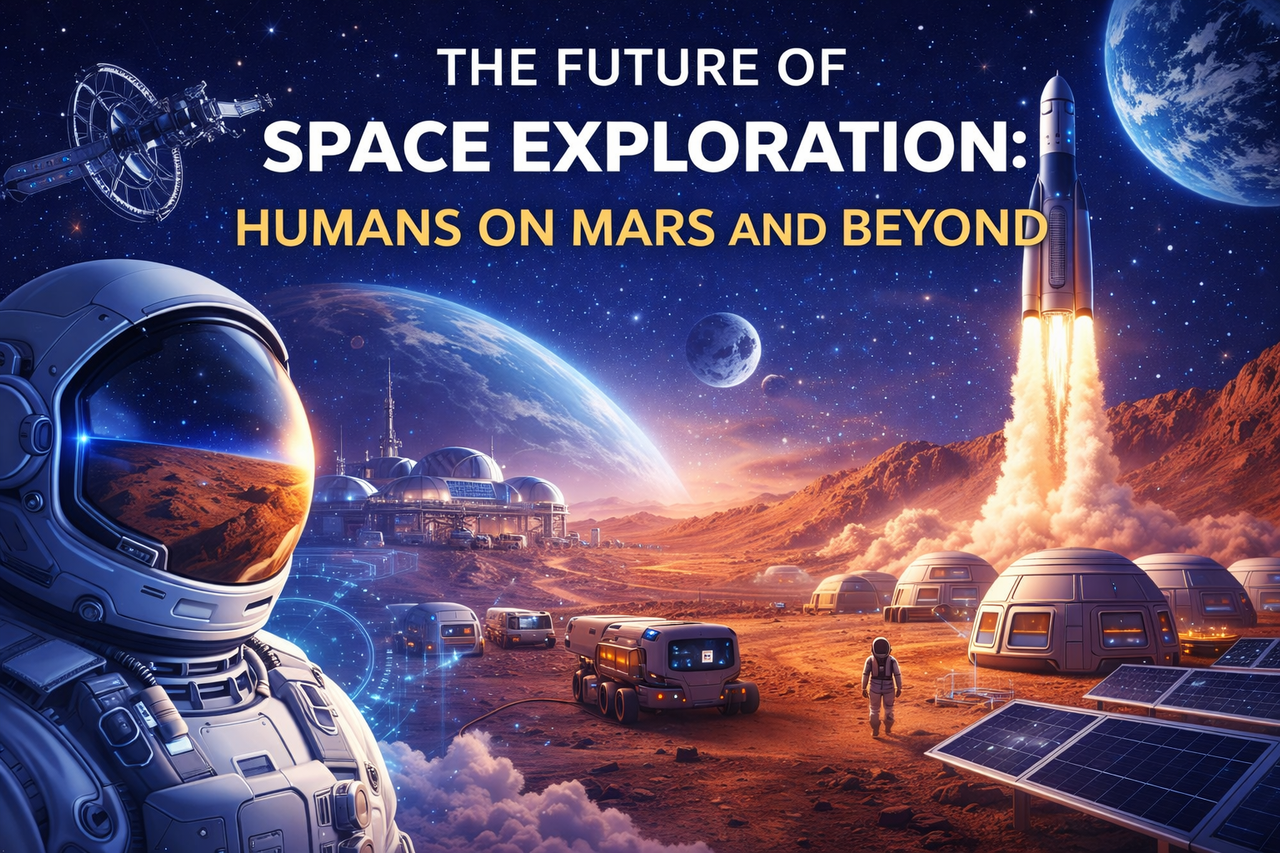
The Future of Space Exploration: Humans on Mars and Beyond
Space exploration has always been one of humanity’s greatest ambitions. From the early days of rocket science to modern missions exploring distant planets, humans have constantly pushed the boundaries of what is possible. Today, technological advancements and global cooperation are bringing humanity closer than ever to exploring and possibly living beyond Earth.
The coming decades could mark a new chapter in human history as space agencies and private companies work toward sending astronauts to Mars, building lunar bases, and expanding human presence in space.
The Early Achievements of Space Exploration
The modern era of space exploration began in the 20th century with intense scientific competition and innovation. One of the most historic moments occurred in 1969 when the spacecraft Apollo 11 successfully landed humans on the Moon.
Astronauts Neil Armstrong and Buzz Aldrin became the first humans to walk on the lunar surface, marking a major milestone in space history.
This mission demonstrated that humans could travel beyond Earth and safely return home, inspiring generations of scientists, engineers, and explorers.
Renewed Interest in the Moon
In recent years, there has been renewed interest in returning to the Moon. Space agencies believe the Moon could serve as a testing ground for technologies needed for deeper space missions.
The Artemis Program aims to send astronauts back to the Moon and establish a sustainable human presence there. This program includes plans for lunar research stations and advanced spacecraft that will support long-term exploration.
The Moon could also become a location for scientific research and resource exploration. Some scientists believe lunar resources could help support future missions to Mars.
The Mission to Mars
Mars has long been considered one of the most promising destinations for human exploration. The planet shares several similarities with Earth, including seasonal weather patterns and evidence that liquid water once existed on its surface.
Space agencies and private companies are actively planning missions to send humans to Mars within the coming decades. One of the major organizations involved in this effort is SpaceX.
The company’s founder, Elon Musk, has repeatedly expressed his vision of building a self-sustaining human colony on Mars.
Although significant technological challenges remain, advancements in rocket technology and spacecraft design are bringing this goal closer to reality.
The Role of Private Space Companies
In the past, space exploration was primarily led by government agencies. Today, private companies are playing a growing role in advancing space technology.
Companies like SpaceX and Blue Origin are developing reusable rockets that significantly reduce the cost of launching missions into space.
Reusable rocket technology has already revolutionized the space industry by making space travel more affordable and accessible.
As private investment continues to grow, the commercial space sector may expand rapidly in the coming years.
Space Tourism
Another emerging trend in space exploration is space tourism. Several companies are working on spacecraft designed to carry private passengers on short trips to space.
Space tourism could allow ordinary people to experience the unique view of Earth from orbit. Although these trips are currently very expensive, technological progress may gradually reduce costs and make space tourism more accessible.
In the future, space hotels and orbital travel experiences may become part of a new industry focused on space-based tourism.
Scientific Discoveries Beyond Earth
Space exploration is not only about human travel; it also plays a critical role in scientific discovery. Space telescopes, robotic probes, and planetary missions help scientists understand the origins of the universe and search for signs of life beyond Earth.
Exploration missions continue to study planets, moons, asteroids, and distant galaxies. These missions provide valuable information about the formation of our solar system and the potential for life elsewhere in the universe.
Future missions may also explore the icy moons of Jupiter and Saturn, which scientists believe could contain subsurface oceans.
Challenges of Deep Space Exploration
Despite the excitement surrounding space exploration, there are many challenges that must be addressed.
Some of the most significant obstacles include:
-Long-distance travel and communication delays
-Protection from cosmic radiation
-Sustainable life-support systems
-High mission costs
Astronauts traveling to Mars, for example, may spend several months in space before reaching their destination.
Developing technologies that can support long-term human survival in space will be essential for successful deep-space missions.
The Future of Human Life in Space
The idea of humans living beyond Earth is becoming increasingly realistic. Some scientists believe that establishing human settlements on other planets could help ensure the long-term survival of humanity.
Space colonies may initially begin as research stations, similar to those in Antarctica. Over time, they could develop into permanent communities.
Advanced technologies such as artificial habitats, hydroponic farming systems, and renewable energy sources could support life in space environments.
Although this vision may take decades to fully realize, progress in space technology suggests that humanity's future may extend far beyond our home planet.
Conclusion
Space exploration continues to inspire humanity with the possibility of discovering new worlds and expanding human knowledge. Advances in rocket technology, international cooperation, and private investment are accelerating progress toward ambitious goals such as returning to the Moon and sending humans to Mars.
While many challenges remain, the next few decades could witness some of the most significant achievements in the history of exploration. Humanity may soon enter an era where living and working beyond Earth becomes a reality.
The dream of exploring the universe is no longer limited to science fiction. With continued innovation and determination, the future of space exploration may lead humanity to Mars and beyond.
You can read more:
-Artemis II Mission Explained: NASA’s Next Human Journey Around the Moon (2026 Guide)



Comments
Post a Comment