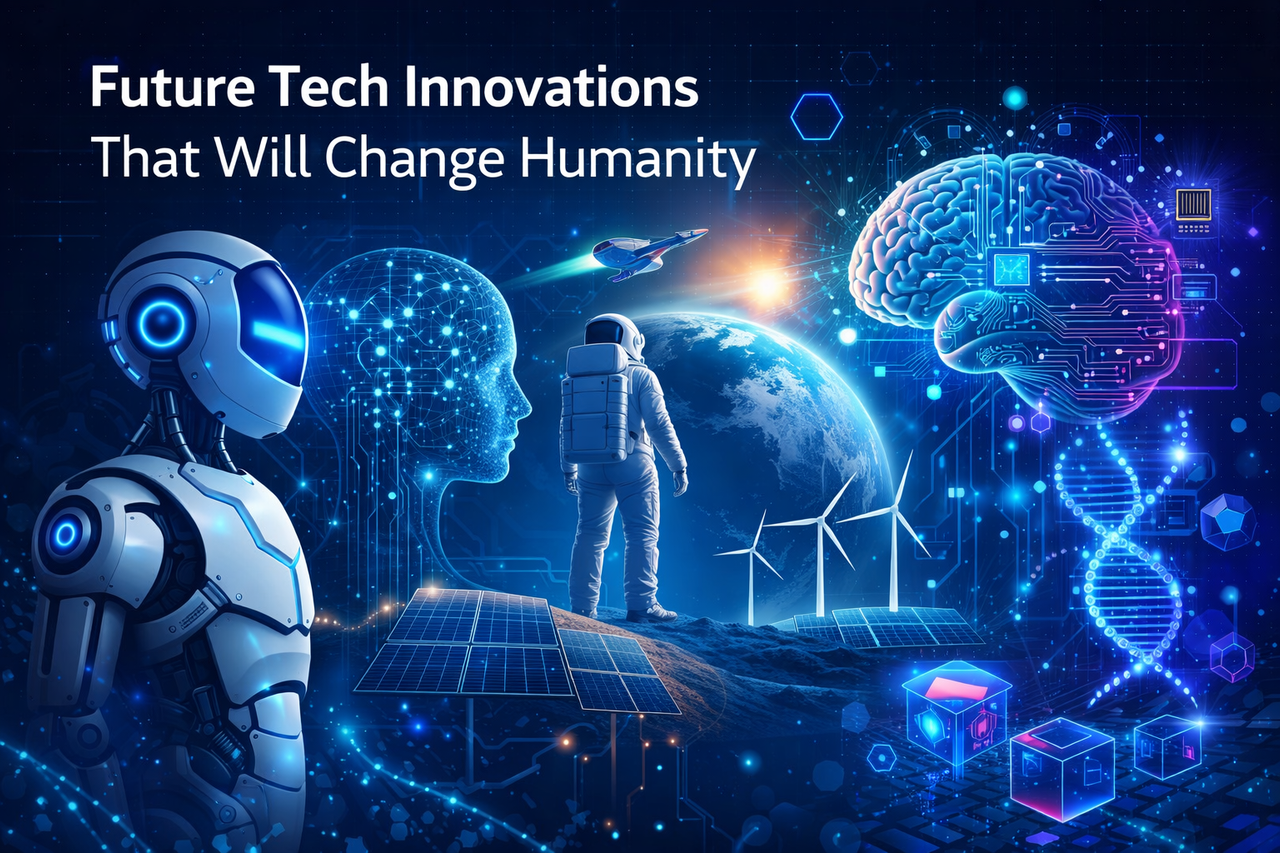
Future Tech Innovations That Will Change Humanity
Technology has always been the driving force behind human progress. From the discovery of fire to the invention of the internet, each technological leap has reshaped societies, economies, and cultures. Today, the pace of innovation is faster than ever, and the next generation of technologies could fundamentally transform how humanity lives, works, and interacts with the world. Even societal norms and values will be reshaped accordingly.
Scientists, engineers, doctors and entrepreneurs are developing revolutionary systems that may solve global challenges, improve human health, expand our presence in space, and redefine the limits of human potential. Technologies once considered science fiction are quickly becoming reality.
This article explores some of the most important future technologies that could reshape humanity in the coming decades.
Artificial Intelligence and the Rise of Intelligent Systems
One of the most transformative technologies of the 21st century is Artificial Intelligence. AI systems are designed to perform tasks that normally require human intelligence, such as learning, problem-solving, language understanding, and decision-making.
Over the past decade, AI has advanced rapidly thanks to improvements in computing power, large datasets, and sophisticated algorithms. Today, AI is used in voice assistants, recommendation systems, medical analysis, and autonomous vehicles.
In the future, AI could revolutionize many industries, including healthcare, education, and transportation. In medicine, AI systems may analyze patient data to detect diseases earlier and recommend personalized treatments. Doctors could use AI to improve diagnostic accuracy and develop better therapies.
Education may also change dramatically. Intelligent tutoring systems could adapt learning materials to each student’s abilities, helping people learn faster and more effectively. AI-powered research tools might assist scientists in making discoveries that would otherwise take decades.
However, the rapid development of AI also raises important ethical questions. Society must consider issues such as data privacy, algorithmic bias, and the potential impact of automation on employment. Responsible development and regulation will be essential to ensure AI benefits humanity as a whole.
Biotechnology and the Future of Human Health
Advances in Biotechnology are opening new possibilities in medicine and human health. Scientists are now able to analyze and modify genetic information with unprecedented precision.
One of the most revolutionary tools in biotechnology is CRISPR Gene Editing, which allows researchers to modify DNA sequences within living organisms. This technology has the potential to eliminate genetic diseases such as sickle cell anemia, cystic fibrosis, and certain forms of inherited blindness.
In the future, gene editing may also allow scientists to enhance disease resistance, improve immune systems, and develop personalized medical treatments based on a person's unique genetic profile.
Another promising development is regenerative medicine. Researchers are exploring ways to grow human tissues and organs in laboratories using stem cells. This could solve the global shortage of donor organs and provide life-saving treatments for millions of patients.
Biotechnology could also improve agriculture by creating crops that are more resistant to pests, diseases, and climate change. These innovations could help ensure food security for a growing global population.
Despite its promise, biotechnology must be handled carefully. Ethical concerns surrounding genetic modification, particularly in human embryos, require careful regulation and public discussion.
Brain–Computer Interfaces and Human Enhancement
Another groundbreaking field involves the connection between the human brain and digital systems through Brain–Computer Interface technology.
Brain–computer interfaces (BCIs) allow direct communication between the brain and external devices. Sensors placed on or inside the brain can detect neural signals and translate them into commands that control computers, prosthetic limbs, or other machines.
This technology could dramatically improve the lives of people with disabilities. For example, individuals who have lost the ability to move due to spinal cord injuries might use BCIs to control robotic limbs or communicate through digital devices.
Companies such as Neuralink are developing implantable brain chips that aim to restore vision, treat neurological disorders, and potentially enhance cognitive abilities.
In the distant future, brain–computer interfaces might even enable humans to interact directly with artificial intelligence systems or share thoughts digitally. While these ideas sound futuristic, early versions of this technology are already being tested.
However, such developments also raise concerns about privacy, security, and the potential misuse of brain data. As the technology evolves, clear ethical guidelines will be necessary.
Quantum Computing and the Next Computing Revolution
Traditional computers process information using bits that represent either a 0 or a 1. In contrast, Quantum Computing uses quantum bits, or qubits, which can exist in multiple states simultaneously due to the principles of quantum mechanics.
This unique capability allows quantum computers to perform certain calculations far more efficiently than classical computers. Problems that would take traditional machines thousands of years could potentially be solved in minutes.
Quantum computing could revolutionize fields such as cryptography, materials science, drug discovery, and climate modeling. Scientists might use quantum simulations to design new medicines or discover advanced materials for energy storage and renewable power systems.
Major technology companies including IBM and Google are investing billions of dollars into quantum research. While practical quantum computers are still under development, many experts believe they will become a reality within the next few decades.
When fully developed, quantum computing could unlock scientific discoveries that were previously impossible.
Space Exploration and the Expansion of Humanity
Humanity has always been fascinated by the stars, and the next frontier of technological innovation may take us beyond Earth. Organizations such as NASA and private companies like SpaceX are leading the new era of space exploration.
Reusable rocket technology has significantly reduced the cost of launching spacecraft, making space missions more accessible. Future plans include establishing permanent research bases on the Moon and eventually sending humans to Mars.
Space exploration could provide valuable resources, scientific knowledge, and new opportunities for humanity. Asteroid mining, for example, may allow us to access rare minerals that are scarce on Earth.
Additionally, expanding human presence beyond Earth could help ensure the long-term survival of our species in case of global catastrophes.
Space technology also benefits life on Earth. Satellite systems support communication networks, weather forecasting, navigation services, and environmental monitoring.
As space travel becomes more advanced, commercial space tourism may also become a reality for more people.
Renewable Energy and Sustainable Technologies
One of the greatest challenges facing humanity is climate change. To address this issue, scientists and engineers are developing new forms of sustainable energy that reduce reliance on fossil fuels.
Innovations in solar and wind power are making renewable energy more efficient and affordable. Advanced battery technologies allow energy generated from renewable sources to be stored and used when needed.
Green hydrogen is another promising solution. By using renewable electricity to split water into hydrogen and oxygen, scientists can produce a clean fuel that generates only water when burned.
Smart power grids are also being developed to distribute energy more efficiently and reduce waste. These systems use advanced sensors and data analytics to balance electricity supply and demand.
By combining renewable energy technologies with sustainable infrastructure, future societies may significantly reduce carbon emissions and protect the planet for future generations.
Autonomous Transportation and Smart Cities
Transportation is another area undergoing rapid transformation. Autonomous vehicles powered by AI are being developed by companies such as Tesla and Waymo.
Self-driving cars have the potential to reduce traffic accidents, improve fuel efficiency, and make transportation more accessible to people who cannot drive.
Future cities may integrate autonomous vehicles with smart infrastructure, including intelligent traffic systems and connected public transportation networks.
Urban areas may also adopt smart city technologies that use sensors and data analytics to improve waste management, energy usage, and public safety.
These innovations could make cities more efficient, environmentally friendly, and comfortable places to live.
The Ethical Responsibility of Innovation
While technological progress offers tremendous opportunities, it also brings new challenges. Issues such as digital privacy, cybersecurity, economic inequality, and environmental impact must be carefully addressed.
Governments, scientists, and technology companies must work together to create regulations and ethical frameworks that guide the responsible development of new technologies.
Education and public awareness will also play a crucial role. As technology becomes more integrated into daily life, people must understand both its benefits and potential risks.
Responsible innovation ensures that technological advancements improve human well-being without creating unintended harm.
Conclusion
The future of humanity will be shaped by the technologies we develop today. Innovations in artificial intelligence, biotechnology, quantum computing, space exploration, renewable energy, and smart infrastructure are likely to transform nearly every aspect of human life.
These advancements could help solve some of the world's most pressing problems, including disease, environmental challenges, and resource scarcity. At the same time, society must ensure that technological progress is guided by ethical principles and a commitment to the common good.
As we move forward into an increasingly digital and interconnected world, the choices humanity makes today will determine how technology shapes the future of our civilization. With careful planning and responsible innovation, future technologies have the potential to create a safer, healthier, and more prosperous world for generations to come.
You can read more:
-How Artificial Intelligence Is Transforming Daily Life Across the World
-Global Cybersecurity Challenges in the Digital Era: Protecting Data and Digital Infrastructure
-Green Technology Innovations Changing the World and Driving Sustainable Development
-The Global Chip War: How Semiconductors Control the Future
-Who Controls AI? Europe, US, and China in a Global Tech Battle



Comments
Post a Comment