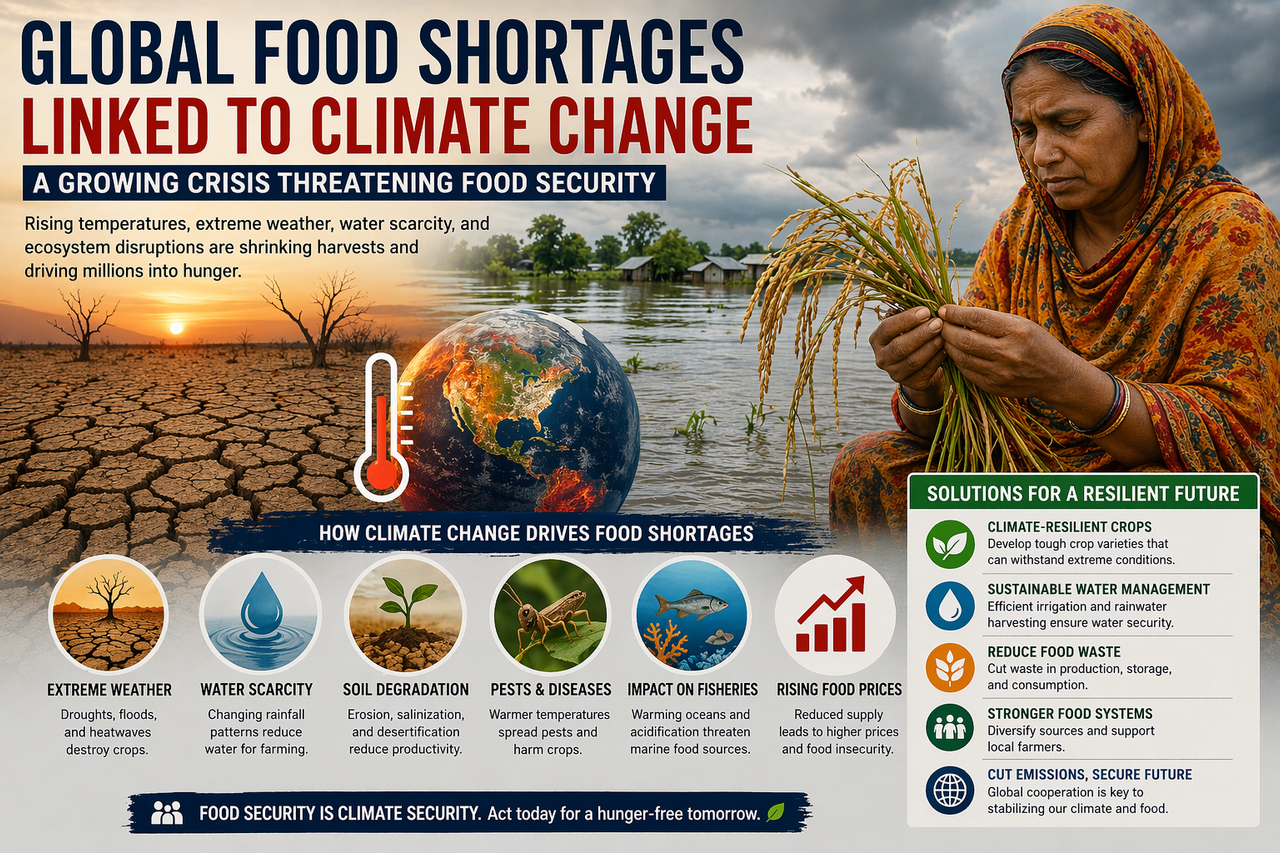
Global Food Shortages Linked to Climate Change: A Growing Crisis Threatening Food Security
Introduction: Food Security in an Uncertain Climate Era
Food is the foundation of human survival, economic stability, and social order. Yet today, global food systems are under increasing pressure. Across continents, millions of people are facing rising food prices, declining crop yields, and uncertainty about future food availability.
While factors such as conflict, population growth, and economic instability contribute to food shortages, climate change has emerged as one of the most significant and complex drivers of this crisis.
According to the Intergovernmental Panel on Climate Change, changing climate patterns are already affecting agricultural productivity worldwide. These impacts are not theoretical—they are measurable, visible, and increasingly disruptive.
From my perspective, global food shortages are no longer isolated events. They are part of a broader structural shift in how food is produced, distributed, and consumed in a changing climate.
Understanding the Climate–Food Connection
Agriculture has always depended on stable environmental conditions. Predictable rainfall, moderate temperatures, and fertile soil are essential for crop growth and livestock health.
Climate change disrupts these fundamentals.
Why This Matters More Than Ever
- Agriculture feeds over 8 billion people globally
- It employs a significant portion of the world’s workforce
- It is deeply interconnected with global trade systems
When climate patterns shift, the entire food system becomes vulnerable.
In my view, one of the biggest misconceptions is that food shortages only affect poorer nations. In reality, climate-driven disruptions in one region can quickly affect global supply chains, impacting food prices and availability worldwide.
Extreme Weather Events: The Immediate Threat to Food Production
Droughts: The Silent Crop Killer
Prolonged droughts are among the most destructive climate-related events for agriculture.
They:
- Dry out soil moisture
- Reduce water availability
- Damage crop growth cycles
Regions such as sub-Saharan Africa and parts of South Asia have experienced repeated drought cycles in recent years.
From my perspective, drought is particularly dangerous because it develops gradually, giving farmers little time to adapt.
Flooding: Too Much Water, Too Little Control
While some regions face water scarcity, others experience excessive rainfall and flooding.
Flooding can:
- Destroy crops instantly
- Erode fertile soil
- Damage storage infrastructure
In major rice-producing regions, even short-term flooding can disrupt annual production cycles.
Heatwaves: The Hidden Yield Reducer
Extreme heat is one of the most underestimated threats to agriculture.
Crops like wheat, maize, and rice are highly sensitive to temperature changes. Even brief heatwaves during critical growth stages can significantly reduce yields.
Livestock are also affected:
- Reduced milk production
- Lower fertility rates
- Increased mortality in extreme cases
In my view, heat stress represents a long-term structural risk that will only intensify as global temperatures rise.
Water Scarcity: The Core Constraint of Future Agriculture
Water is essential for food production, yet climate change is disrupting water availability worldwide.
Key Drivers of Water Scarcity
- Reduced rainfall in some regions
- Overuse of groundwater
- Melting glaciers
- Changing river flows
Agriculture consumes approximately 70% of global freshwater resources. When water becomes scarce, food production inevitably declines.
Regions dependent on glacier-fed rivers are particularly vulnerable. As glaciers shrink, long-term water supply becomes uncertain.
From my perspective, water scarcity may become the single most critical factor shaping global food security in the coming decades.
Soil Degradation and Desertification: Losing the Foundation of Farming
Healthy soil is the backbone of agriculture. However, climate change is accelerating soil degradation.
How Climate Change Damages Soil
- Heavy rainfall washes away topsoil
- Drought reduces soil fertility
- Salinity increases in coastal areas
- Desertification expands arid regions
In regions like the Sahel and parts of the Middle East, land degradation is already limiting agricultural productivity.
What concerns me most is that soil degradation is often irreversible on human timescales. Once fertile land is lost, recovery can take decades.
Pests and Crop Diseases: Expanding Threats in a Warmer World
Warmer temperatures create favorable conditions for pests and diseases.
Key Impacts
- Expansion of pest habitats
- Increased survival rates during winter
- Higher frequency of outbreaks
Farmers are forced to spend more on pesticides and crop protection, increasing production costs.
From my perspective, this is a hidden economic burden that often goes unnoticed in discussions about food security.
Oceans Under Pressure: Declining Marine Food Sources
Climate change is also affecting global fisheries.
Major Threats
- Rising sea temperatures
- Ocean acidification
- Coral reef degradation
- Changing fish migration patterns
Organizations like the Food and Agriculture Organization warn that declining fish stocks could impact millions who rely on seafood as a primary protein source.
For coastal communities, this represents both an economic and nutritional crisis.
Rising Food Prices: The Economic Impact
When supply decreases, prices rise.
Who Is Most Affected?
- Low-income households
- Developing countries
- Urban populations dependent on market purchases
Food price volatility can lead to:
- Increased poverty
- Social unrest
- Political instability
From my perspective, food security is not just about production—it is about affordability and access.
Vulnerable Regions and Populations
Climate change impacts are uneven.
High-Risk Regions
- Sub-Saharan Africa
- South Asia
- Parts of Latin America
High-Risk Groups
- Small-scale farmers
- Coastal communities
- Low-income households
The World Food Programme describes climate change as a “threat multiplier,” intensifying existing vulnerabilities.
In my view, addressing inequality is just as important as addressing climate change itself.
Long-Term Global Risks
If current trends continue, global food systems may face increasing instability.
Potential Future Outcomes
- Reduced yields of major staple crops
- Simultaneous crop failures across regions
- Increased reliance on imports
- Greater competition for resources
These risks are interconnected and could lead to cascading global impacts.
Solutions: Building a Resilient Food System
Climate-Resilient Crops
Developing drought-resistant and heat-tolerant crops can stabilize production.
Sustainable Water Management
Efficient irrigation and water conservation are essential.
Reducing Food Waste
A significant portion of global food is lost before consumption.
Diversification of Agriculture
Relying on multiple crops reduces risk.
Climate Action
Reducing greenhouse gas emissions is critical for long-term stability.
My Perspective: What Needs to Change
Based on current trends, I believe several priorities are essential:
1. Shift Toward Local Resilience
Global systems are fragile. Local food production must be strengthened.
2. Invest in Technology
Innovation can improve efficiency and reduce vulnerability.
3. Address Inequality
Food security solutions must prioritize vulnerable populations.
4. Integrate Climate and Agriculture Policies
These issues cannot be treated separately.
5. Strengthen Global Cooperation
No country can solve this crisis alone.
Conclusion: A Defining Challenge of Our Time
Global food shortages linked to climate change represent one of the most pressing challenges of the 21st century.
The issue is complex, interconnected, and evolving. But it is not unsolvable.
From my perspective, the key lies in recognizing that food security is not just about agriculture—it is about climate, economics, technology, and global cooperation.
The choices made today will determine whether future generations face scarcity or stability.



Comments
Post a Comment