A Comprehensive Analytical Overview of Modern Peacebuilding and Global Stability Trends
Introduction: A Turning Point in Global Diplomacy
In 2026, global diplomacy has reasserted itself as one of the most influential forces shaping international relations. After years of persistent geopolitical tensions, regional conflicts, and shifting power dynamics, the world appears to be entering a phase where negotiation and structured dialogue are once again being prioritized alongside traditional security strategies.
Although conflict has not disappeared—and in many regions remains deeply entrenched—the tone of international engagement has noticeably shifted. Governments, multinational organizations, and regional alliances are increasingly investing in diplomatic channels, ceasefire frameworks, and long-term peacebuilding strategies.
What makes this period particularly significant is not the absence of conflict, but the renewed effort to manage it through cooperation rather than escalation. From my perspective, this shift feels less like a sudden transformation and more like a gradual correction—an acknowledgment that sustained instability carries global consequences that no nation can fully isolate itself from.
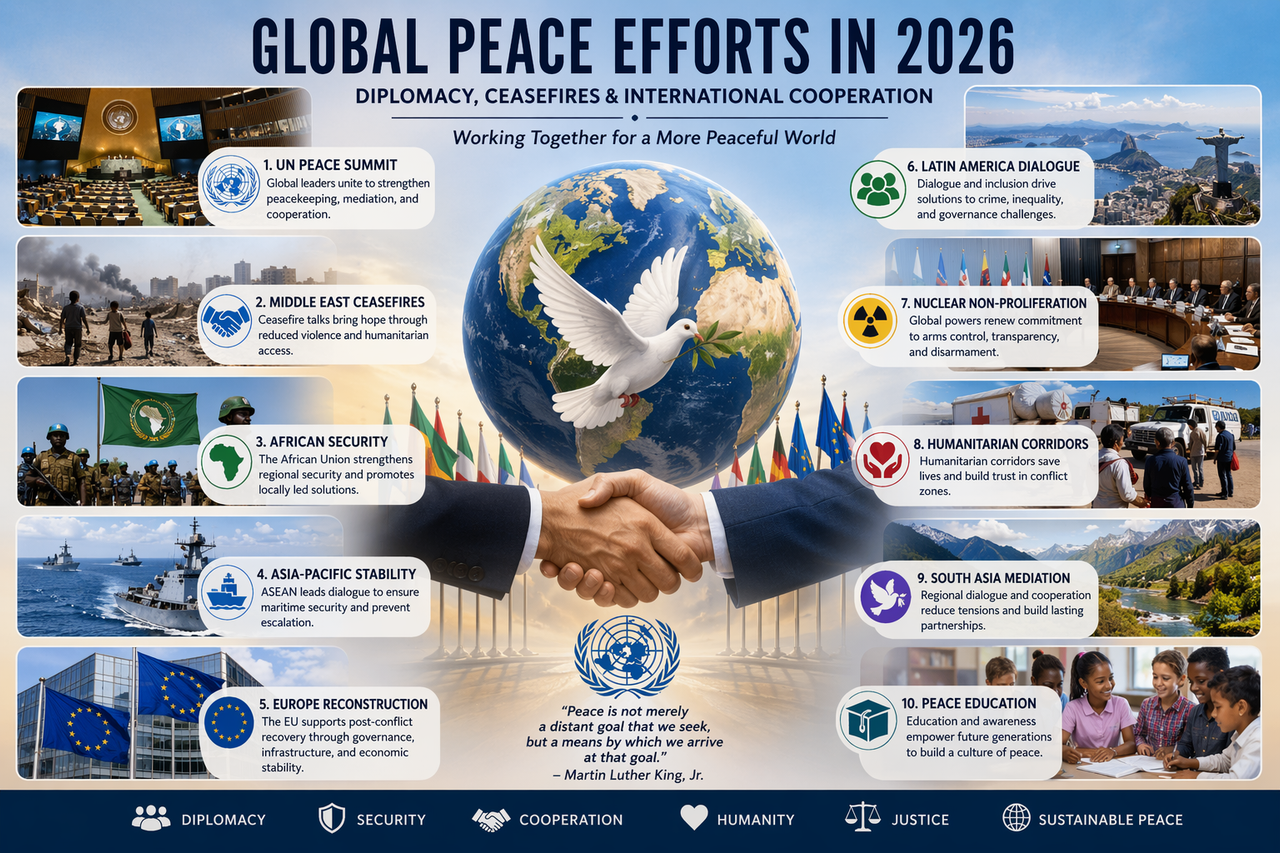
This article explores the key global peace initiatives of 2026, analyzing how diplomacy is evolving and what it may mean for the future of international stability.
1. The United Nations and the Architecture of Global Peace
The United Nations continues to serve as the central platform for multilateral diplomacy in 2026. Its peace summits bring together heads of state, foreign ministers, and international security advisors to address ongoing crises and prevent emerging conflicts from escalating.
Key priorities of the UN peace agenda include:
- Strengthening peacekeeping missions in fragile regions
- Expanding mediation and negotiation frameworks
- Improving humanitarian response coordination
- Preventing escalation in politically unstable areas
Despite criticism regarding effectiveness in certain conflicts, the UN remains unmatched in legitimacy. In many ways, its role is less about enforcing peace and more about creating a structured environment where dialogue remains possible.
From an analytical perspective, the continued reliance on the UN reflects a fundamental truth: global conflicts today are too interconnected for unilateral solutions. Even rival powers often find it necessary to operate within the UN framework to maintain international legitimacy.
Personally, I see the UN not as a perfect institution, but as a necessary one—an imperfect yet essential platform that prevents diplomacy from fragmenting entirely.
2. Ceasefire Dynamics in the Middle East: Fragile but Significant Progress
One of the most closely watched developments in 2026 is the series of ceasefire agreements emerging in parts of the Middle East. While these agreements vary in scope and durability, they collectively signal a cautious movement toward de-escalation.
Notable developments include:
- Reduction in active hostilities in selected regions
- Expansion of humanitarian corridors
- Increased involvement of international mediators
- Periodic prisoner exchanges and temporary truces
However, the fragility of these arrangements cannot be overlooked. Ceasefires often serve as temporary pauses rather than permanent solutions. They depend heavily on political will, trust-building, and external monitoring mechanisms.
A key challenge is that underlying issues—such as territorial disputes, governance struggles, and historical grievances—remain unresolved.
In my view, these ceasefires represent a necessary breathing space rather than a final resolution. They create conditions where deeper political negotiations might eventually take place, but they do not guarantee lasting peace on their own.
3. The African Union and Regional Security Transformation
The African Union (AU) continues to strengthen its role in regional peace and security, reflecting a broader shift toward African-led solutions for African challenges.
Major initiatives include:
- Enhanced intelligence-sharing systems across member states
- Coordinated border security operations
- Expansion of regional peacekeeping missions
- Joint counter-terrorism strategies
This approach is particularly significant because it reflects growing confidence in regional institutions. Instead of relying heavily on external intervention, African nations are increasingly taking ownership of their security challenges.
From a broader analytical perspective, this shift is crucial. Historically, externally imposed solutions have often struggled due to limited local understanding. Regional cooperation, by contrast, tends to be more adaptable and context-sensitive.
Personally, I view this as one of the most promising developments in global peacebuilding—because it emphasizes sustainability over short-term stabilization.
4. Asia-Pacific Maritime Diplomacy: Stability in a High-Stakes Region
The Asia-Pacific region remains one of the most strategically sensitive areas in global geopolitics. In 2026, diplomatic engagement led by regional organizations such as ASEAN continues to focus on reducing maritime tensions.
Key diplomatic priorities include:
- Ensuring freedom of navigation in international waters
- Negotiating resource-sharing arrangements
- Establishing conflict de-escalation protocols
- Encouraging military transparency measures
The region’s importance lies not only in its geopolitical complexity but also in its economic centrality. Global trade flows heavily depend on maritime stability in this area.
A disruption here would have consequences far beyond regional boundaries, affecting global supply chains and economic stability.
From my perspective, the Asia-Pacific situation demonstrates how deeply interconnected modern peace has become with economic systems. Stability is no longer just a political goal—it is an economic necessity.
5. Europe’s Focus on Post-Conflict Reconstruction and Institutional Stability
The European Union continues to play a leading role in post-conflict reconstruction efforts, emphasizing long-term stability over immediate crisis response.
Key focus areas include:
- Institutional governance reforms
- Infrastructure rebuilding programs
- Economic recovery initiatives
- Strengthening rule-of-law systems
This approach reflects an understanding that peace is not simply the absence of war, but the presence of functioning institutions and economic opportunity.
Europe’s model increasingly emphasizes structural stability—ensuring that post-conflict regions do not relapse into instability due to weak governance or economic collapse.
Analytically, this represents a shift in global thinking: peacebuilding is no longer treated as a short-term intervention but as a decades-long process.
6. Latin America: Addressing Root Causes Through Dialogue
Across Latin America, governments are increasingly adopting dialogue-based approaches to address internal instability, particularly in relation to organized crime, inequality, and institutional trust.
Key initiatives include:
- Anti-corruption reforms and transparency policies
- Community-based security programs
- Social inclusion and education initiatives
This model is particularly interesting because it focuses less on force and more on addressing structural drivers of instability.
From an analytical standpoint, this reflects a deeper understanding of conflict: violence often emerges not only from political disputes but also from economic and social inequality.
Personally, I find this approach compelling because it acknowledges that sustainable peace must be built from the ground up, not imposed from the top down.
7. Nuclear Non-Proliferation Talks: Managing Global Risk
In 2026, nuclear non-proliferation discussions have regained importance amid shifting global power dynamics.
Key objectives include:
- Increasing transparency in nuclear programs
- Strengthening compliance verification mechanisms
- Preventing escalation of arms competition
- Reinforcing international treaties
These discussions are highly sensitive, yet essential. Even limited breakdowns in communication between nuclear powers could have global consequences.
From a strategic perspective, nuclear diplomacy is less about elimination in the short term and more about risk management and stabilization.
In my view, these talks represent one of the most critical but least visible forms of diplomacy in the modern world.
8. Humanitarian Corridors: Diplomacy in Action
Humanitarian corridors continue to serve as one of the most practical expressions of peace efforts in active conflict zones.
Their primary functions include:
- Delivering food, medicine, and essential supplies
- Facilitating civilian evacuation
- Allowing safe passage for aid organizations
However, these corridors depend heavily on temporary ceasefire agreements and neutral monitoring mechanisms.
They often represent the first tangible sign that opposing sides are willing to cooperate, even minimally.
Analytically, humanitarian corridors can be seen as entry points into broader peace negotiations, where trust begins to form in small, measurable steps.
9. South Asia: Preventive Diplomacy and Regional Balance
South Asia continues to prioritize preventive diplomacy as a tool for maintaining regional stability.
Key focus areas include:
- Military confidence-building measures
- Expansion of trade cooperation
- Joint infrastructure and development initiatives
Given the region’s population density and strategic sensitivity, even minor tensions can have significant implications.
From a broader perspective, preventive diplomacy in South Asia reflects a shift toward avoiding escalation rather than managing conflict after it occurs.
Personally, I believe this preventive approach is one of the most efficient forms of diplomacy when consistently applied.
10. Peace Education: Building Stability from Within
One of the most long-term and impactful developments in 2026 is the growing emphasis on peace education.
Core objectives include:
- Encouraging intercultural understanding
- Reducing susceptibility to extremism
- Strengthening community resilience
- Promoting civic engagement and dialogue
Education-based peacebuilding recognizes that political agreements alone are insufficient if societies remain divided or vulnerable to radicalization.
From an analytical standpoint, this is perhaps the most sustainable form of peace investment. It does not produce immediate results, but its long-term effects can reshape entire generations.
In my opinion, peace education is often underestimated in global policy discussions, despite being one of the most powerful tools for preventing future conflict.
Global Outlook for 2026: A Complex but Evolving Landscape
The global peace environment in 2026 reflects a mixture of progress, fragility, and ongoing uncertainty. While tensions remain in several regions, there is a clear shift toward:
- Multilateral diplomacy
- Regional security responsibility
- Humanitarian cooperation
- Long-term reconstruction strategies
- Preventive conflict management
This suggests that the international system is not becoming more peaceful overnight, but it is becoming more structured in how it approaches peace.
Final Analysis: Progress Without Guarantees
From a balanced perspective, the global peace initiatives of 2026 represent meaningful but incomplete progress. The increased emphasis on diplomacy and cooperation reflects a positive shift in international behavior, yet the durability of these efforts remains uncertain.
Several factors will determine future outcomes:
- Political commitment from major global powers
- Consistency in diplomatic engagement
- Inclusion of local and regional stakeholders
- Effective implementation of agreements
Peacebuilding, ultimately, is not a singular achievement but a continuous process shaped by patience, trust, and sustained cooperation.
As 2026 continues to unfold, the world stands at a delicate intersection between conflict and collaboration. While uncertainty remains, there is also a cautious sense of optimism that diplomacy—despite its challenges—remains one of humanity’s most important tools for preventing large-scale instability.



Comments
Post a Comment