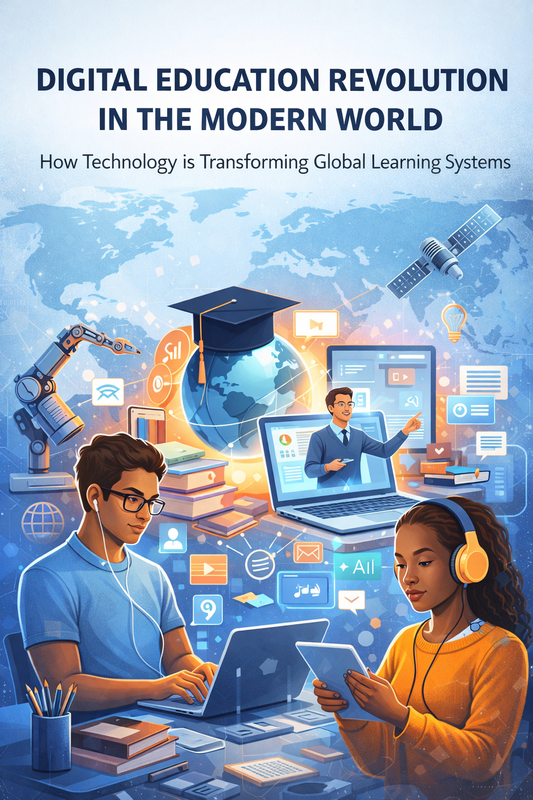
Digital Education Revolution in the Modern World
Introduction
Education has always been a cornerstone of human development, shaping societies and empowering individuals to achieve their potential. In the 21st century, however, education is undergoing a major transformation driven by digital technology. The traditional classroom model, once defined by textbooks, chalkboards, and face-to-face lectures, is rapidly evolving into a dynamic digital learning environment.
The rise of online learning platforms, virtual classrooms, artificial intelligence tools, and interactive digital resources has created what experts call the digital education revolution. This transformation is not only changing how students learn but also redefining the roles of teachers, institutions, and governments in the global education system.
Digital education has become particularly important in recent years as technological advancements and global events accelerated the adoption of remote learning systems. Today, millions of students around the world rely on digital platforms to access education, develop skills, and connect with educators.
The Rise of Digital Learning Platforms
One of the most visible signs of the digital education revolution is the rapid growth of online learning platforms. These platforms provide courses, tutorials, certifications, and degree programs accessible to learners from almost anywhere in the world.
Major education technology companies such as Coursera, Udemy, and edX have played a significant role in expanding digital learning opportunities. These platforms partner with universities and industry experts to provide high-quality educational content across a wide range of subjects.
Students can now learn programming, business management, graphic design, data science, and many other skills online without needing to attend traditional classes. Many courses are self-paced, allowing learners to study according to their own schedules.
This accessibility has democratized education, making knowledge available to people who may not have access to traditional universities due to geographic, financial, or social barriers.
Technology Transforming the Learning Experience
Digital technology is not simply replacing traditional classrooms—it is transforming the entire learning experience.
Interactive tools such as video lectures, quizzes, simulations, and discussion forums enable students to engage more actively with educational content. Instead of passively listening to lectures, students can participate in virtual activities that reinforce learning.
Artificial intelligence is also playing an increasingly important role in education. AI-powered learning systems can analyze student performance and adapt lessons to individual learning styles. These personalized learning experiences help students understand difficult topics more effectively.
For example, AI tutors can recommend additional resources when students struggle with certain concepts. This approach improves learning outcomes and ensures that students receive support tailored to their needs.
Expansion of Virtual Classrooms
Virtual classrooms have become a central component of digital education. Using video conferencing tools and collaborative software, teachers can conduct live lessons with students located in different parts of the world.
During the global disruptions caused by the COVID-19 pandemic, many schools and universities adopted online classes to maintain educational continuity. Platforms like Zoom and Google Meet became essential tools for teachers and students.
Even after schools reopened, many institutions continued to use hybrid learning models that combine in-person instruction with digital resources. This blended approach allows educators to provide more flexible learning opportunities.
Virtual classrooms also encourage collaboration through shared documents, group discussions, and interactive presentations. Students can participate in global learning communities that extend beyond physical classrooms.
Advantages of Digital Education
The digital education revolution offers several important benefits for students, educators, and institutions.
Accessibility
Digital education allows students from remote regions to access high-quality educational content without traveling long distances. This is particularly beneficial for learners in developing countries where educational resources may be limited.
Flexibility
Online learning platforms provide flexible schedules that accommodate different lifestyles. Students can study at their own pace, balancing education with work or family responsibilities.
Cost Efficiency
Traditional education often involves significant costs such as tuition, accommodation, and transportation. Digital learning platforms frequently offer more affordable courses and free educational resources.
Skill Development
Digital education helps students develop essential skills for the modern workforce, including digital literacy, online communication, and self-directed learning.
Challenges Facing Digital Education
Despite its many advantages, digital education also presents several challenges that must be addressed to ensure its effectiveness.
Digital Divide
Not all students have equal access to reliable internet connections, computers, or digital devices. In many parts of the world, limited infrastructure creates barriers to online education.
This digital divide can widen educational inequalities between urban and rural communities or between developed and developing nations.
Lack of Personal Interaction
Traditional classrooms provide opportunities for face-to-face communication, social interaction, and collaborative learning. Online learning environments may sometimes lack these human elements.
Educators are working to address this challenge by incorporating interactive discussions, group projects, and virtual engagement tools into online courses.
Quality Assurance
As digital education grows, maintaining quality standards becomes increasingly important. Governments and educational institutions must ensure that online courses meet academic requirements and provide credible certifications.
Role of Governments and Educational Institutions
Governments and universities play a crucial role in supporting the digital education revolution. Many countries are investing in digital infrastructure, online learning platforms, and teacher training programs.
Educational institutions are also redesigning curricula to incorporate digital tools and technology-driven learning strategies. Universities are developing online degree programs that allow students to earn recognized qualifications remotely.
Policy makers are focusing on expanding internet access, improving digital literacy, and ensuring that digital education remains inclusive and accessible to all learners.
The Future of Digital Education
The future of education will likely involve a combination of traditional classroom teaching and advanced digital learning technologies. Hybrid learning models are expected to become more common as schools integrate digital tools into their educational systems.
Emerging technologies such as virtual reality (VR), augmented reality (AR), and immersive simulations could further transform the learning experience. These technologies allow students to explore historical sites, conduct scientific experiments, or practice professional skills in virtual environments.
Artificial intelligence will also continue to improve personalized learning systems, helping students receive customized educational support.
Experts predict that lifelong learning will become increasingly important in the digital age. As industries evolve and new technologies emerge, individuals will need continuous education to remain competitive in the workforce.
Digital education platforms will play a key role in providing ongoing training and skill development opportunities.
Conclusion
The digital education revolution represents one of the most significant transformations in modern education. Technology is breaking down traditional barriers and making learning more accessible, flexible, and personalized.
While challenges such as digital inequality and quality assurance remain, continued innovation and global collaboration can help overcome these obstacles.
By embracing digital education, societies can create more inclusive learning systems that empower individuals with the knowledge and skills needed to succeed in the rapidly changing world.
As technology continues to evolve, the future of education will likely be defined by a powerful combination of human creativity and digital innovation.
You can read more:
-How AI is Changing the World and Tranforming the Realistic Scenario in this Modern Age
-How Artificial Intelligence Is Transforming Daily Life Across the World
-Who Controls AI? Europe, US, and China in a Global Tech Battle
-The Global Chip War: How Semiconductors Control the Future



Comments
Post a Comment