Artificial intelligence is no longer a distant concept confined to science fiction. It has quietly and rapidly integrated itself into the fabric of everyday life. From the way people communicate and work to how they think, decide, and even feel, AI is transforming human experience at a fundamental level.
But beyond algorithms and automation, the real story of AI is deeply human.
It is a story about uncertainty and opportunity, empowerment and anxiety, connection and isolation. It is about how people are adapting—not just technically, but emotionally and philosophically—to a world where machines can simulate aspects of human intelligence.
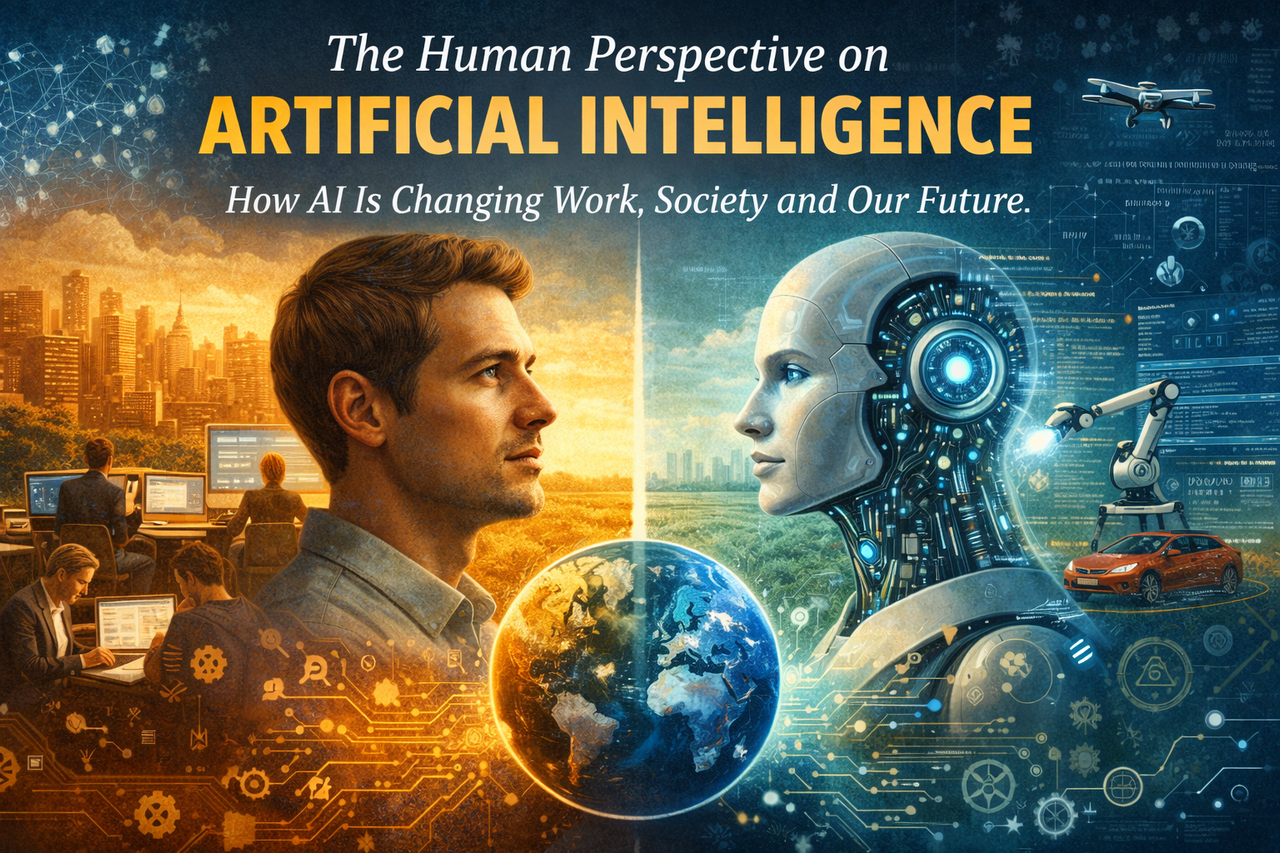
This article explores artificial intelligence not just as a technological revolution, but as a human one.
1. Work Is Becoming Smarter — and More Uncertain
The workplace is one of the first and most visible areas where artificial intelligence is making a profound impact.
Tasks that once required hours of concentration—data analysis, report writing, customer responses—can now be completed in seconds. AI-powered tools are reshaping productivity, allowing individuals and organizations to achieve more with less effort.
Major technology companies like Microsoft and Google are embedding AI into everyday tools such as word processors, spreadsheets, and communication platforms. This integration means that AI is no longer a specialized tool—it is becoming a standard part of work.
The Human Experience
From a human perspective, this transformation is both empowering and unsettling.
On one hand:
-Workers feel more productive and efficient
-Routine tasks are reduced, freeing time for creative and strategic thinking
-Individuals can perform at a higher level regardless of experience
On the other hand:
-Job security feels increasingly uncertain
-Roles are changing faster than people can adapt
-Traditional career paths are becoming less predictable
The nature of “value” in the workplace is shifting. It is no longer about how quickly someone can perform a task, but how effectively they can guide, interpret, and supervise intelligent systems.
This creates a psychological shift. Workers are not just learning new tools—they are redefining their identity within the workforce.
2. Decision-Making Is Becoming Shared with Machines
What makes this transformation significant is not just technological progress, but the shift in human dependence on intelligent systems. As AI becomes embedded in everyday decisions, individuals may gradually rely more on machine-generated insights than personal judgment. This raises long-term questions about human independence, critical thinking, and the balance between efficiency and control.
Human decision-making has historically been rooted in experience, intuition, and reasoning. Today, AI is becoming an active participant in that process.
Algorithms recommend what people should watch, what they should buy, which routes they should take, and even how diseases should be diagnosed. In fields like healthcare, finance, and law, AI is augmenting human judgment with data-driven insights.
Organizations like OpenAI are developing systems capable of generating language, ideas, and solutions that closely resemble human thinking.
The Human Experience
This shift introduces a new kind of relationship between humans and decisions.
Benefits include:
-Faster and more accurate analysis
-Reduced cognitive burden
-Increased access to information
However, it also raises critical concerns:
-Who is responsible when AI makes a mistake?
-Can people trust systems they do not fully understand?
-Does reliance on AI weaken human judgment over time?
This creates a subtle but powerful psychological tension. Humans are no longer the sole decision-makers—they are collaborators with machines.
Over time, this may change how people perceive authority, responsibility, and even autonomy.
3. Human Creativity Is Being Redefined
Creativity has long been considered one of the most uniquely human traits. It is tied to emotion, imagination, and personal experience.
Today, AI systems can:
-Write stories and articles
-Generate visual art
-Compose music
-Design products and interfaces
What once required human inspiration can now be simulated by algorithms trained on vast datasets.
The Human Experience
This transformation is reshaping how people think about creativity itself.
Some individuals feel:
-Inspired by new creative possibilities
-Empowered to bring ideas to life more easily
-Excited about collaboration between humans and machines
Others feel:
-Concerned about loss of originality
-Threatened by the idea of machine-generated art
-Uncertain about ownership and authorship
The core question becomes:
What does it mean to create?
Creativity is no longer just about producing something new—it is about interaction between human intention and machine capability.
This shift may redefine art, culture, and intellectual property in ways that are still unfolding.
4. Human Relationships with Technology Are Becoming Emotional
Technology has traditionally been viewed as a tool—something functional and impersonal.
AI is changing that.
People now:
-Talk to virtual assistants
-Seek advice from chat systems
-Engage with AI companions
These interactions can feel surprisingly natural. AI systems respond in ways that mimic human conversation, creating a sense of presence.
The Human Experience
This introduces a new emotional dimension to technology.
Positive effects:
-Reduced loneliness for some individuals
-Increased accessibility of support and information
-New forms of companionship
Concerns:
-Potential weakening of real human relationships
-Emotional dependence on machines
-Confusion between simulation and genuine connection
Humans are entering unfamiliar psychological territory—forming connections with entities that appear responsive but do not possess consciousness or emotion.
This raises deeper questions about what relationships mean in a digital age.
5. Economic Power Is Concentrating — and Expanding
Artificial intelligence is not just transforming individuals—it is reshaping global economics.
Developing advanced AI systems requires:
-Massive datasets
-High computational power
-Significant financial investment
This gives large technology companies a substantial advantage.
Companies like Tesla are leveraging AI across industries, from autonomous driving to robotics and energy systems.
The Human Experience
From a human perspective, this creates a dual reality.
Opportunities:
-New industries and job roles
-Increased efficiency and productivity
-Global innovation acceleration
Risks:
-Growing economic inequality
-Concentration of power in a few organizations
-Unequal access to AI technologies
At a global level, nations are competing for leadership in AI, recognizing it as a key driver of future economic and geopolitical power.
For individuals, this raises concerns about fairness, access, and inclusion.
6. Human Identity Is Being Questioned
Perhaps the most profound impact of AI is philosophical.
For centuries, humans have defined themselves by traits such as intelligence, creativity, and reasoning. AI challenges these assumptions.
Machines can now:
-Solve complex problems
-Generate ideas
-Mimic human communication
The Human Experience
This leads to fundamental questions:
-What makes humans unique?
-Is intelligence the same as understanding?
-Can machines truly “think,” or are they only simulating thought?
These questions are not just academic—they affect how people see themselves.
AI forces humanity to confront its own nature:
-The difference between knowledge and wisdom
-The role of emotion in intelligence
-The meaning of consciousness
In this sense, AI acts as a mirror, reflecting both the capabilities and limitations of human beings.
7. The Emotional Reality: Hope and Fear Coexist
The rise of AI is not defined by a single emotion—it is a mixture of optimism and anxiety.
Hope
AI offers the potential for:
-Medical breakthroughs and improved healthcare
-Safer transportation through automation
-Faster scientific discovery
-Greater access to knowledge and education
Fear
At the same time, it raises concerns about:
-Job displacement and economic disruption
-Loss of privacy and surveillance
-Misinformation and manipulation
-Loss of human control over powerful systems
The Human Balance
This coexistence of hope and fear defines the current AI era.
People are navigating a complex emotional landscape, trying to embrace innovation while managing its risks.
8. Ethics, Responsibility, and the Human Role
As AI becomes more powerful, ethical considerations become increasingly important.
Key questions include:
-How should AI systems be designed and regulated?
-Who is accountable for their actions?
-How can bias and inequality be minimized?
Human responsibility remains central.
AI does not make decisions independently—it reflects the data, goals, and values programmed into it.
This means:
-Ethical AI requires ethical humans
-Responsible innovation depends on human judgment
-The future of AI is shaped by human choices
9. The Future of Human-AI Coexistence
Looking ahead, the relationship between humans and AI will continue to evolve.
Possible directions include:
-Deeper integration of AI into daily life
-Increased collaboration between humans and machines
-New forms of education focused on adaptability and critical thinking
The future is not about replacing humans—it is about redefining what humans do best.
Skills such as:
-Creativity
-Emotional intelligence
-Ethical reasoning
-Complex problem-solving
will become more valuable in an AI-driven world.
Final Reflection: AI as a Mirror of Humanity
Artificial intelligence is often described as a tool, a technology, or a system.
But from a human perspective, it is something more.
It is a mirror.
AI reflects:
-Human intelligence and creativity
-Human biases and inequalities
-Human ambitions and fears
It amplifies whatever is built into it.
The most important question is not:
-“What can AI do?”
But rather:
-“What do humans choose to do with it?”
The future of artificial intelligence is not predetermined.
It will be shaped by decisions made today—by individuals, organizations, and societies.
In the end, the story of AI is not about machines becoming powerful.
It is about humans deciding what kind of world they want to create.
This article is for informational and analytical purposes, focusing on the broader human impact of artificial intelligence.
You can read more:
-How Artificial Intelligence Is Transforming Daily Life Across the World
-Net5.5G Revolution Unveiled at MWC 2026: Global Broadband Enters AI Era
-Rise of AI Assistants in 2026: How Artificial Intelligence Is Transforming Work and Society
-Technology Competition Between Global Superpowers: The New Cold War Without Missiles
-Rise of Remote Work Technologies: How Digital Innovation Is Transforming Global Employment
-Future of Automation and Human Employment: Risks, Opportunities and Global Impact
-Global Cybersecurity Challenges in the Digital Era: Protecting Data and Digital Infrastructure



Comments
Post a Comment