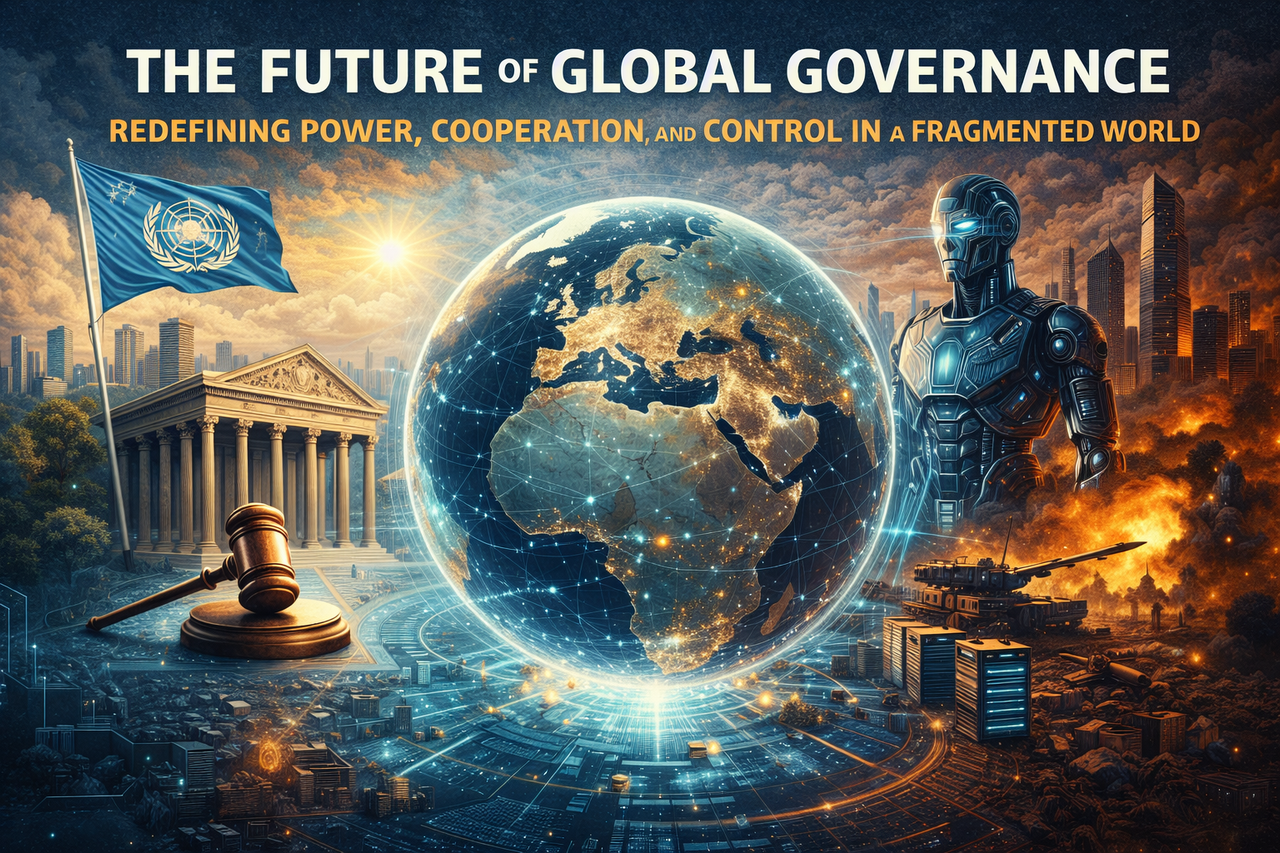
The Future of Global Governance Systems: Redefining Power, Cooperation, and Control in a Fragmented World
The architecture of global governance is undergoing one of the most significant transformations in modern history. Built in the aftermath of global conflict and designed for a vastly different world, the institutions that once guided international cooperation now face unprecedented pressure from geopolitical rivalry, technological disruption, economic inequality, and planetary crises.
At its core, global governance refers to the systems, institutions, rules, and norms that regulate interactions among nations and address issues that transcend borders. For decades, this system provided a framework for stability, enabling cooperation in trade, security, development, and humanitarian efforts.
Yet today, the world is no longer defined by the conditions that shaped these institutions. Power is diffusing across regions, technology is redefining sovereignty, and global challenges are becoming more complex and interconnected.
This raises a critical question:
Can global governance systems evolve fast enough to remain relevant, or are we entering a new era of fragmented and competing governance models?
The Historical Foundation: A System Built for Stability
Modern global governance structures were largely established in the mid-20th century following the devastation of World War II. The creation of the United Nations marked a collective effort to prevent future conflicts and promote international cooperation.
Complementing this political framework were economic institutions such as the International Monetary Fund and the World Bank. These organizations were designed to stabilize global economies, facilitate reconstruction, and promote development.
For decades, this system functioned relatively effectively. It contributed to economic growth, reduced the likelihood of large-scale war among major powers, and established norms around human rights, trade, and diplomacy.
However, the system had inherent limitations:
-It reflected the power dynamics of a few dominant nations
-Decision-making structures often favored developed countries
-It was not designed for the complexities of globalization and digital transformation
As the global landscape evolved, these limitations became increasingly evident.
The Shift to a Multipolar World
One of the most defining trends shaping the future of global governance is the emergence of a multipolar world.
In contrast to the post-Cold War era—when the United States held dominant global influence—power is now distributed across multiple centers. Countries such as China and India have risen as major economic and political forces, while regional players like Brazil and others are asserting greater influence.
This shift has several implications:
Increased Representation
More countries now demand a voice in global decision-making, challenging traditional hierarchies.
Greater Competition
Geopolitical rivalries complicate cooperation, particularly in areas such as trade, technology, and security.
Slower Consensus
With more stakeholders involved, reaching agreement on global issues becomes more difficult.
Global governance systems must adapt to this reality by becoming more inclusive and flexible. Without reform, they risk losing legitimacy and effectiveness.
Technology and the Transformation of Governance
Technology is not only reshaping economies and societies—it is fundamentally altering governance itself.
Artificial intelligence, big data, blockchain, and digital communication are changing how decisions are made, how policies are implemented, and how power is distributed.
Organizations such as OpenAI, along with major technology firms, are playing an increasingly influential role in shaping global norms around AI ethics, data privacy, and digital regulation.
Key Areas of Impact
1. Data as a Strategic Resource
Data has become one of the most valuable assets in the modern world. Control over data flows and digital infrastructure is now a central issue in global governance.
2. Cybersecurity and Digital Conflict
Cyberattacks and digital espionage have introduced new dimensions of conflict, requiring international cooperation and new regulatory frameworks.
3. Algorithmic Decision-Making
AI systems are influencing decisions in healthcare, finance, and governance, raising questions about accountability and transparency.
4. Digital Sovereignty
Countries are increasingly seeking to control their digital ecosystems, leading to fragmentation of the global internet.
Technology presents both opportunities and risks. While it enables more efficient governance, it also challenges traditional notions of authority and control.
Climate Change: The Ultimate Test of Global Cooperation
Among all global challenges, climate change stands out as the most urgent and complex.
It is a problem that transcends borders, affects every nation, and requires coordinated global action.
The Paris Agreement represents a landmark effort to address climate change through international cooperation. However, its effectiveness depends on the willingness of countries to meet their commitments.
Key Challenges
-Conflicting economic priorities between developed and developing nations
-Limited enforcement mechanisms
-Unequal distribution of climate impacts
The Future of Climate Governance
To succeed, global governance systems must:
-Strengthen accountability mechanisms
-Increase financial support for developing countries
-Encourage innovation in clean energy and sustainability
Climate change is not just an environmental issue—it is a governance challenge that will define the future of international cooperation.
Economic Governance in an Unequal World
Global economic governance is facing increasing scrutiny as inequality persists both within and between countries.
Institutions like the World Bank and the International Monetary Fund have played key roles in promoting development, but critics argue that reforms are needed.
Key Issues
1. Debt and Financial Stability
Many developing countries face high levels of debt, limiting their ability to invest in growth and development.
2. Trade Imbalances
Global trade systems often favor more developed economies, creating disparities.
3. Access to Technology
Unequal access to technology exacerbates economic inequality.
Emerging Trends
-Calls for reforming global financial institutions
-Increased South-South cooperation
-Exploration of alternative economic models
Economic governance must evolve to address these challenges and ensure inclusive growth.
Global Health Governance After COVID-19
The COVID-19 pandemic exposed significant weaknesses in global health governance systems.
The World Health Organization played a central role in coordinating responses, but the crisis revealed gaps in preparedness, coordination, and equity.
Lessons Learned
-The importance of rapid information sharing
-The need for stronger global coordination
-The challenge of ensuring equitable access to vaccines and treatments
Future Directions
-Strengthening global health surveillance systems
-Improving funding and resources for international health organizations
-Enhancing cooperation between countries
Global health governance will be a critical component of future resilience.
The Growing Role of Regional Governance
As global systems face challenges, regional organizations are becoming more influential.
Examples include:
-European Union
-Association of Southeast Asian Nations
-African Union
These organizations offer several advantages:
-Greater cultural and political alignment
-Faster decision-making
-More targeted solutions
The future of global governance may involve a layered system where regional and global institutions work together.
Non-State Actors and the Expansion of Governance
Global governance is no longer limited to governments.
Non-state actors—including corporations, NGOs, and civil society—are playing increasingly important roles.
Examples
-Technology companies shaping digital policy
-NGOs advocating for environmental and human rights issues
-Academic institutions contributing research and expertise
This diversification creates a more complex but also more dynamic governance landscape.
Reform, Innovation, or Fragmentation?
The future of global governance may follow several possible paths:
1. Reform
Updating existing institutions to reflect modern realities.
2. Innovation
Creating new governance models that leverage technology and inclusivity.
3. Fragmentation
A breakdown of global cooperation leading to competing systems.
Most likely, the future will involve a combination of all three.
Toward Adaptive and Inclusive Governance
The most promising vision for global governance is one that is adaptive, inclusive, and resilient.
Key Characteristics
-Flexibility in responding to new challenges
-Inclusion of diverse voices and perspectives
-Integration of technology in decision-making
Rather than a single centralized system, global governance may evolve into a network of interconnected institutions and actors.
Conclusion: A Turning Point for Humanity
The future of global governance systems will shape the trajectory of the 21st century.
As the world becomes more interconnected and complex, the need for effective cooperation becomes more urgent.
The challenge is not just technical or political—it is fundamentally human.
Can nations work together despite differences?
Can institutions adapt to new realities?
Can humanity build systems that are fair, effective, and sustainable?
The answers to these questions will determine not only the future of governance but the future of the world itself.
You can read more:
-United Nations Role in Global Peacekeeping
-Global Diplomatic Maneuvers Intensify as Trade Tensions and Tech Regulation Reshape World Order
-Global and Regional Headlines in 2026: Diplomatic Shifts, Legal Reforms, and Economic Policy Changes Reshaping the World



Comments
Post a Comment