An in-Depth Analysis of Modern Diplomacy at the Intersection of Economics, Technology, and Geopolitics
Introduction: Diplomacy in a Rapidly Transforming World
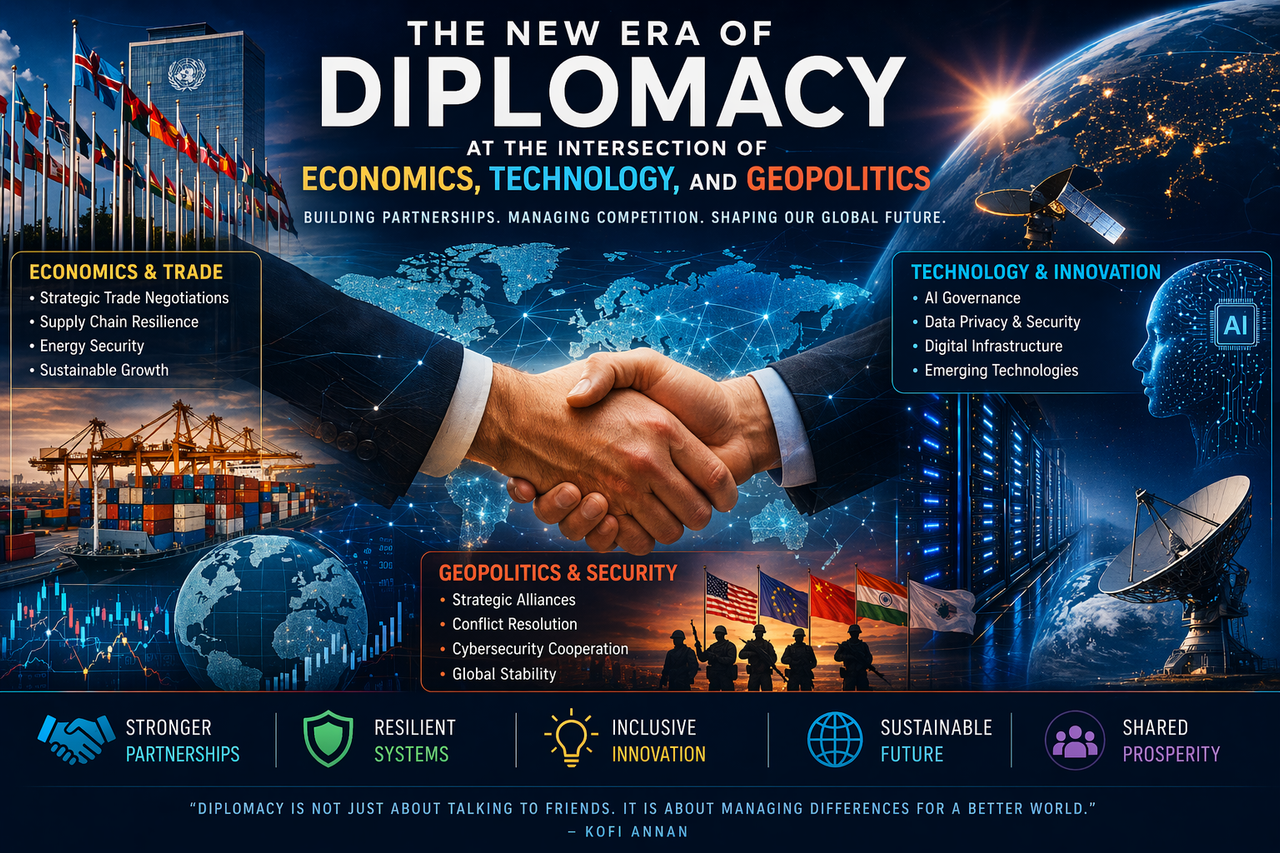
As of March 2026, global diplomacy is undergoing a profound transformation. What was once dominated by military alliances, territorial negotiations, and traditional geopolitical rivalries has evolved into a far more complex and layered system of interaction. Today’s diplomatic landscape extends deeply into trade policy, technological regulation, digital sovereignty, and supply chain security.
Governments across the world are recalibrating their strategies to adapt to an increasingly interconnected yet fragmented global environment. Trade tensions continue to simmer, technology companies face growing regulatory scrutiny, and economic interdependence is being reassessed through the lens of national security.
From my perspective, what makes this moment particularly significant is not just the presence of tension—but the redefinition of what diplomacy itself means. Diplomacy is no longer confined to embassies and summits; it is embedded in data flows, semiconductor production lines, and artificial intelligence frameworks.
This article explores the evolving nature of global diplomacy in 2026, examining how trade negotiations, tech regulation, and strategic competition are reshaping the international order.
1. The Evolution of Modern Diplomacy
Over the past decade, diplomacy has shifted from a largely state-centric, treaty-driven process into a multidimensional framework that involves economic policy, technological governance, and regulatory coordination.
Key characteristics of modern diplomacy include:
- Integration of economic and security priorities
- Expansion into digital and technological domains
- Increased involvement of non-state actors, including corporations
- Greater emphasis on regulatory alignment across borders
Unlike traditional diplomacy, which often focused on resolving conflicts after they emerged, modern diplomacy is increasingly preventive and adaptive.
For instance, governments now engage in negotiations not only to resolve disputes but to anticipate risks—such as supply chain disruptions, cyber threats, or technological dependencies.
In my view, this shift reflects a broader realization: global stability is no longer determined solely by military balance, but by the resilience of economic and technological systems.
2. Trade Tensions and Strategic Economic Negotiations
Trade remains one of the central arenas of diplomatic engagement in 2026. While large-scale trade wars have somewhat subsided compared to earlier years, underlying tensions persist.
Current diplomatic priorities in trade include:
- Reducing tariffs in strategically sensitive sectors
- Protecting intellectual property rights
- Managing export controls for advanced technologies
- Ensuring access to critical raw materials
- Strengthening regional trade partnerships
A key concept shaping these negotiations is “de-risking”—a strategy aimed at reducing overdependence on specific countries without fully severing economic ties.
This approach represents a middle ground between globalization and protectionism.
From an analytical standpoint, de-risking acknowledges a difficult reality: while economic interdependence creates vulnerability, complete decoupling is neither practical nor beneficial.
Countries are therefore seeking flexibility rather than separation, maintaining trade relationships while diversifying supply chains.
3. Supply Chains as Strategic Assets
One of the most significant shifts in global diplomacy is the recognition of supply chains as strategic assets rather than purely economic systems.
The disruptions experienced during the early 2020s exposed vulnerabilities in global production networks, particularly in sectors such as semiconductors, pharmaceuticals, and energy.
Diplomatic initiatives now focus on:
- Creating resilient and diversified supply chains
- Establishing early-warning systems for disruptions
- Coordinating stockpiles of essential goods
- Increasing transparency in sourcing critical materials
Semiconductors, in particular, have become a focal point of diplomatic negotiations. These components are essential for everything from consumer electronics to defense systems.
As a result, governments are investing heavily in domestic production while forming alliances to secure supply chains.
In my opinion, this shift represents one of the most consequential changes in global economic policy—transforming supply chains from efficiency-driven systems into security-oriented frameworks.
4. Europe’s Expanding Role in Technology Regulation
Europe has emerged as a leading force in shaping global technology regulation. In 2026, regulatory frameworks are expanding beyond competition law to address broader concerns related to digital platforms.
Key areas of focus include:
- Algorithm transparency and accountability
- Data privacy and cross-border data flows
- Regulation of artificial intelligence systems
- Oversight of online marketplaces
- Management of misinformation and harmful content
European policymakers argue that large technology companies hold significant influence over markets, public discourse, and personal data. As such, regulation is seen as necessary to ensure fairness, accountability, and user protection.
From a broader perspective, Europe’s approach is influencing global standards. Many countries are adopting similar frameworks, creating a ripple effect across international markets.
However, this regulatory expansion also introduces complexity. Companies operating globally must navigate varying compliance requirements, which can increase costs and operational challenges.
Personally, I see this as a balancing act—regulation is essential for accountability, but excessive fragmentation could hinder innovation and global cooperation.
5. The Rise of Digital Sovereignty
Digital sovereignty has become one of the defining concepts in contemporary diplomacy. It refers to a nation’s ability to control its digital infrastructure, data, and technological systems.
Drivers of digital sovereignty include:
- National security concerns
- Economic competitiveness in AI and digital services
- Protection of citizen data
- Desire for technological independence
Governments are implementing policies such as:
- Data localization requirements
- Restrictions on foreign technology providers
- Investment in domestic cloud infrastructure
- Development of national cybersecurity frameworks
While these measures enhance control and security, they also risk fragmenting the global digital ecosystem.
Analysts often warn of a potential “splinternet”—a scenario where the internet becomes divided into regional or national segments with limited interoperability.
From my perspective, digital sovereignty reflects a natural response to technological dependence, but its long-term implications for global connectivity remain uncertain.
6. Technology as a Tool of Diplomacy
Technology is no longer just an object of regulation—it is also a powerful diplomatic tool.
Countries are leveraging technological cooperation to strengthen alliances and expand influence.
Examples of tech-driven diplomacy include:
- Joint artificial intelligence research initiatives
- Cross-border cybersecurity partnerships
- Satellite and space technology collaborations
- Digital infrastructure investment programs
Emerging economies are particularly important in this context. As they expand digital access and infrastructure, they become key partners in global technology ecosystems.
This has led to increased competition among major powers to provide:
- Telecommunications infrastructure
- Cloud services
- Digital payment systems
- Smart city technologies
From an analytical standpoint, technology diplomacy represents a new form of soft power—one that shapes global influence through infrastructure and innovation rather than traditional political means.
7. Multilateral Institutions in a Changing Environment
Despite criticisms, multilateral institutions remain essential in facilitating global dialogue.
Organizations focused on trade, finance, and international cooperation continue to provide platforms for negotiation and coordination.
Their roles include:
- Mediating disputes between nations
- Setting international standards
- Coordinating responses to global crises
- Promoting economic stability
However, progress within these institutions is often slow due to competing national interests.
In today’s fragmented world, achieving consensus is increasingly difficult. Yet, the importance of maintaining dialogue cannot be overstated.
In my view, multilateral institutions serve as anchors of stability, even when their effectiveness is limited.
8. Investor Confidence and Market Reactions
Diplomatic developments have direct and immediate impacts on global financial markets.
Key market sensitivities include:
- Trade agreements and tariff changes
- Regulatory announcements affecting technology firms
- Geopolitical tensions and sanctions
- Supply chain disruptions
Investors closely monitor diplomatic signals to assess risk and opportunity.
For example:
- Escalating tensions often lead to market volatility
- Constructive negotiations can boost investor confidence
- Regulatory clarity can stabilize long-term investment decisions
Technology companies, in particular, are highly sensitive to regulatory developments. While stricter regulations may increase compliance costs, they can also create a more predictable operating environment.
From a broader perspective, financial markets have become an extension of diplomacy—reacting in real time to policy decisions and geopolitical shifts.
9. Balancing Cooperation and Strategic Competition
One of the defining challenges of modern diplomacy is balancing cooperation with competition.
Economic interdependence encourages collaboration, but national security concerns drive caution.
This duality is reflected in:
- Trade partnerships combined with export controls
- Technological collaboration alongside regulatory restrictions
- Diplomatic dialogue amid strategic rivalry
Countries are increasingly adopting hybrid strategies—engaging in cooperation where beneficial while protecting critical sectors.
This dynamic is unlikely to disappear. Instead, it may define global relations for the foreseeable future.
From my perspective, this balance is inherently unstable but necessary. Complete cooperation is unrealistic, yet complete confrontation would be too costly.
10. The Future of Global Diplomacy
Looking ahead, several key developments are likely to shape the next phase of global diplomacy:
Emerging focus areas include:
- Governance frameworks for artificial intelligence
- International agreements on cross-border data flows
- Climate-related trade and sustainability standards
- Semiconductor and critical technology alliances
- Cybersecurity cooperation treaties
As technological innovation accelerates, diplomacy will need to evolve just as rapidly.
One of the central challenges will be maintaining global cooperation in an increasingly fragmented regulatory environment.
Conclusion: Navigating a Complex Global Order
Global diplomatic maneuvering in 2026 reflects a world in transition. Trade, technology, and security are no longer separate domains—they are deeply interconnected elements of a broader geopolitical framework.
Governments are working to stabilize economic relationships while asserting greater control over strategic sectors. This has transformed diplomacy into a multidimensional process that spans trade negotiations, regulatory frameworks, and technological collaboration.
From a balanced analytical perspective, the current trajectory suggests neither complete fragmentation nor full cooperation. Instead, the world appears to be moving toward a managed interdependence, where countries remain connected but increasingly cautious.
Personally, I see this as a pragmatic evolution rather than a breakdown of globalization. The system is adapting to new realities rather than collapsing under them.
Ultimately, the success of global diplomacy in this era will depend on:
- Flexibility in policy-making
- Transparency in negotiations
- Willingness to engage despite differences
- Ability to balance national interests with global stability
As nations continue to navigate this complex terrain, one thing remains clear: diplomacy—however transformed—will remain essential in shaping the future of the global order.
You can read more:
-International Cooperation for Global Peace and Stability in a Changing World
-World War and Peace: Causes, Consequences, and the Path Toward Global Stability
-Global Peace Efforts in 2026: Diplomacy, Ceasefires & International Cooperation



Comments
Post a Comment