Global Broadband Transformation Accelerates as Net5.5G Emerges at Mobile World Congress 2026
The global telecommunications industry is entering what may prove to be one of its most decisive transitions since the rollout of 4G over a decade ago. At Mobile World Congress 2026 in Barcelona, industry leaders, policymakers, and technology firms converged to unveil a forward-looking vision for the future of connectivity — one defined not merely by faster speeds, but by intelligent, adaptive, and deterministic networks.
At the center of this transformation is the emergence of Net5.5G, a framework that signals a shift in how global broadband infrastructure is conceptualized, deployed, and governed.
While previous generations of mobile and broadband technology focused largely on increasing bandwidth and reducing latency, Net5.5G represents something more fundamental: the integration of intelligence into the network itself.
This shift comes at a time when global data consumption, artificial intelligence workloads, and cloud dependency are expanding at unprecedented rates — forcing the telecommunications sector to rethink its role not just as a service provider, but as a critical enabler of the digital economy.
Beyond Speed: Understanding the Net5.5G Paradigm
Net5.5G is often described as an “evolution” of 5G, but that framing understates its significance. In practice, it reflects a transition toward programmable, AI-native network ecosystems capable of responding dynamically to demand.
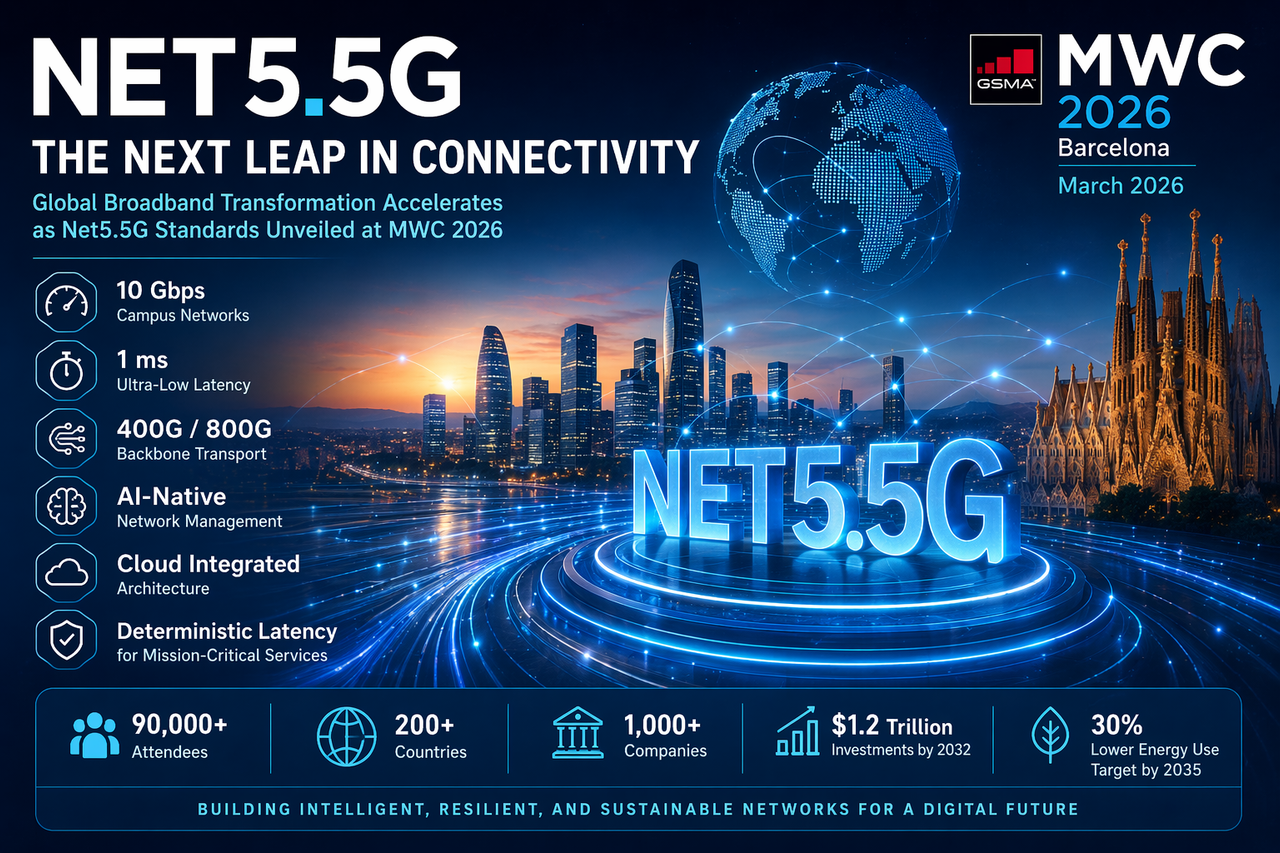
According to standards introduced by the World Broadband Association, Net5.5G networks are expected to support:
- Ultra-high throughput (10 Gbps and beyond in enterprise environments)
- Deterministic latency as low as 1 millisecond
- 400G and 800G optical backbone transport
- Deep integration with cloud computing architectures
- Autonomous network management driven by AI
Unlike traditional network upgrades, which often involve incremental improvements to hardware, Net5.5G is fundamentally software-defined and intelligence-driven.
Opinion Insight:
This is the point where telecom stops being “infrastructure” and starts becoming a computing platform in its own right. Networks are no longer just pipelines for data — they are evolving into systems that actively manage, optimize, and even predict data flows.
Why Net5.5G Matters More Than 5G Ever Did
When 5G was introduced, it was marketed as a revolutionary leap. In reality, much of its early deployment focused on incremental improvements over 4G, particularly in urban consumer markets.
Net5.5G, by contrast, is being designed with future workloads in mind, not current ones.
Global projections suggest that by 2030:
- Annual IP traffic could exceed 5 zettabytes
- Over 75% of enterprise workloads will be cloud-based
- More than 30 billion IoT devices will be active worldwide
- AI-generated data could dominate network traffic patterns
These trends point to a fundamental mismatch between existing network capabilities and future demand.
Opinion Insight:
5G was about speed.
Net5.5G is about survivability — whether networks can handle the coming explosion of AI-driven data without collapsing under complexity.
The AI Factor: Networks Built for Machines, Not Humans
One of the most important shifts highlighted at MWC 2026 is the rise of machine-driven network demand.
Historically, networks were optimized for human behavior:
- Streaming video
- Browsing websites
- Social media
But the next decade will be dominated by:
- Autonomous vehicles
- AI model training and inference
- Industrial automation
- Smart cities
These systems require:
- Predictable latency
- Guaranteed bandwidth
- Real-time responsiveness
This is where Net5.5G’s concept of deterministic networking becomes critical.
Opinion Insight:
We are moving toward a world where machines are the primary users of the internet. Human traffic will become secondary in terms of volume and importance. Net5.5G is the first serious attempt to design networks for that reality.
Real-World Deployments Signal a Shift
The announcements at Mobile World Congress 2026 were not just theoretical.
European Smart City Pilots
Telecom consortia revealed pilot deployments across Spain and Germany integrating:
- AI-driven traffic systems
- Real-time surveillance and safety networks
- Smart energy distribution
Early results showed:
- Up to 40% latency reduction
- Around 20% energy efficiency gains
These are not marginal improvements — they represent system-level transformation.
Asia-Pacific’s 800G Backbone Leap
Operators in South Korea and Singapore announced large-scale upgrades to 800G optical backbone infrastructure.
This is crucial for:
- Hyperscale data centers
- AI model deployment
- Cloud gaming and streaming ecosystems
Opinion Insight:
Asia is once again positioning itself as the testing ground for next-generation infrastructure, much like it did during early 5G rollout.
Autonomous Networks: The End of Manual Telecom Management?
Perhaps the most transformative aspect of Net5.5G is the shift toward AI-native network operations.
At MWC, companies demonstrated systems capable of:
- Predicting hardware failures
- Automatically rerouting traffic
- Detecting cyber threats in real time
These systems could reduce downtime by up to 45%.
Opinion Insight:
- This raises a critical question:
- If networks manage themselves, what happens to traditional telecom operations?
The industry may be heading toward a future where:
- Human engineers supervise AI
- Decision-making becomes algorithmic
- Operational costs drop — but so do certain job categories
Economic Implications: A Trillion-Dollar Transformation
Broadband infrastructure is no longer just a technical concern — it is a core economic driver.
Studies indicate:
A 10% increase in broadband penetration can boost GDP by 1–1.5% in developing economies
With Net5.5G, the impact could be even greater due to:
- AI-driven productivity gains
- Remote work expansion
- Digital entrepreneurship
Global telecom investment is expected to exceed $1.2 trillion between 2026 and 2032.
Opinion Insight:
Countries that delay adoption risk falling into a new form of inequality — not just a digital divide, but a computational divide.
The Digital Divide: Progress or Polarization?
Despite rapid advancements, the global connectivity gap remains stark:
- Around 2.6 billion people remain offline
- Rural infrastructure in many regions is still underdeveloped
There is a real risk that Net5.5G could:
- Accelerate progress in developed markets
- Leave emerging economies further behind
Opinion Insight:
Technology has always promised to democratize opportunity, but without policy intervention, it often does the opposite — it concentrates advantage.
Cybersecurity: A Growing Threat Landscape
As networks become more intelligent, they also become more vulnerable.
Key concerns include:
- Expanded attack surfaces
- AI-driven cyber threats
- Data privacy risks
Experts are pushing for:
- Zero-trust architectures
- End-to-end encryption
- Quantum-resistant security systems
Opinion Insight:
The smarter the network, the more catastrophic its failure could be. Net5.5G will require security by design, not as an afterthought.
Sustainability: The Hidden Challenge
Telecom networks already consume 2–3% of global electricity.
Net5.5G aims to reduce this through:
- AI-based energy optimization
- Smart network shutdown systems
- Renewable energy integration
Opinion Insight:
There’s a paradox here:
- The digital economy promises efficiency, yet it is becoming one of the largest energy consumers. Net5.5G must solve this contradiction to remain sustainable.
Policy and Regulation: The Silent Decider
Governments will play a decisive role in shaping how Net5.5G unfolds.
Key issues include:
- Spectrum allocation
- Data governance
- Infrastructure funding
- Environmental regulations
Regions like the EU are already aligning policies with next-generation broadband goals.
Opinion Insight:
- Technology may innovate, but policy determines who benefits.
Looking Ahead: The Road to 6G
Net5.5G is widely seen as a stepping stone toward 6G, expected between 2032 and 2035.
Future networks may feature:
- Terahertz spectrum usage
- AI-managed traffic ecosystems
- Fully immersive digital environments
Opinion Insight:
- If 5G connected people and Net5.5G connects machines,
- 6G may connect realities — blending physical and digital worlds seamlessly.
Final Thoughts
The unveiling of Net5.5G at Mobile World Congress 2026 marks more than a technological milestone — it represents a strategic turning point in how societies build, manage, and depend on digital infrastructure.
The question is no longer whether faster networks are needed.
The real question is:
-Who will control the intelligent networks of the future — and who will be left behind?
As the broadband revolution accelerates, the answers will shape not just connectivity, but the global balance of economic and technological power for decades to come.
You can read more:
-Future Tech Innovations That Will Change Humanity in the Next 50 Years
-How Artificial Intelligence Is Transforming Daily Life Across the World
-Global Cybersecurity Challenges in the Digital Era: Protecting Data and Digital Infrastructure



Comments
Post a Comment