Escalating Middle East Tensions and Their Global Ripple Effects: An In-Depth Analysis
Introduction: A World on Edge
The modern global economy is more interconnected than at any other point in human history. Energy markets, trade routes, financial systems, and technological supply chains are tightly woven together in a way that means instability in one region can quickly spread across continents.
In this context, rising tensions in the Middle East—particularly involving Iran, Israel, and the United States—are not just regional concerns. They are global stress signals that affect everything from fuel prices in Europe to inflation in Asia and investment sentiment in North America.
The situation has not yet reached the scale of a full regional war, but the trajectory of events has been enough to trigger anxiety in global markets. Oil prices have become more volatile, airlines are adjusting routes, and governments are quietly preparing for multiple scenarios.
In this article, we will explore not only what is happening, but what it means, why it matters, and how the world should interpret these developments from both an economic and strategic perspective.
1. The Middle East: Why It Matters So Much
To understand why global attention immediately shifts toward the Middle East during crises, we must first recognize its strategic importance.
The region is home to some of the world’s largest proven oil and gas reserves. Countries such as Saudi Arabia, the United Arab Emirates, and Qatar play a central role in global energy exports. Even beyond production, the region contains critical maritime chokepoints.
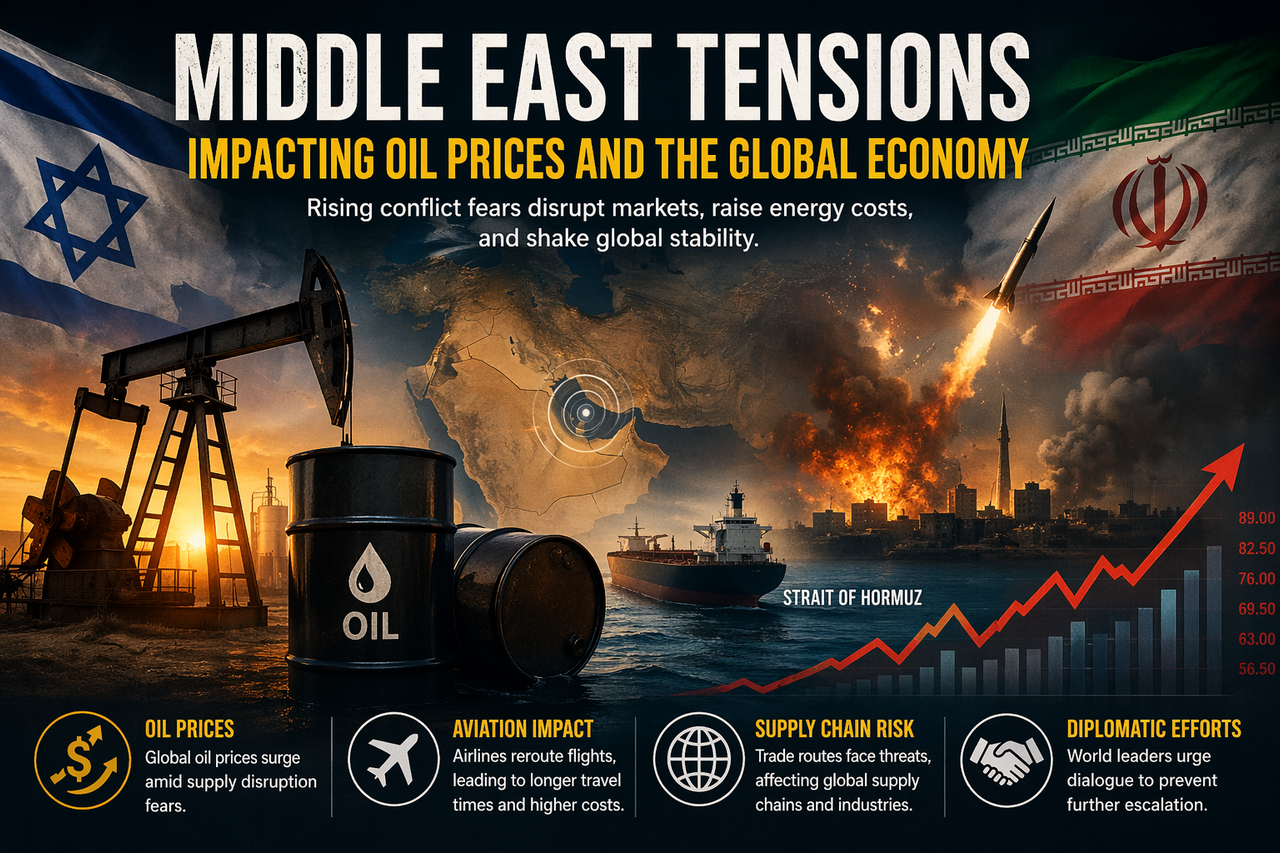
One of the most important is the Strait of Hormuz, a narrow passage connecting the Persian Gulf to the Arabian Sea. A significant portion of the world’s seaborne oil trade passes through this route daily. Any disruption here—whether due to conflict, sanctions, or naval tensions—can immediately impact global prices.
This is why even rumors of instability can move markets.
But energy is only part of the equation. The Middle East also sits at the intersection of Europe, Asia, and Africa. It is a geopolitical bridge—and sometimes a battleground—between global powers.
2. Understanding the Current Tensions: A Complex Web
The current escalation narrative involves multiple layers of conflict, historical grievances, and strategic competition.
At its core, tensions between Iran and Israel have been ongoing for decades, shaped by ideological differences, security concerns, and regional influence struggles.
Meanwhile, the United States plays a significant role as both a military ally to Israel and a major global diplomatic actor attempting to balance deterrence with de-escalation.
However, it is important to emphasize a key analytical point:
Most modern Middle East crises are not isolated conflicts—they are interconnected systems of pressure.
A strike in one area can trigger responses in another. A political decision in Washington can shift military calculations in Tehran. A diplomatic statement from Europe can influence market behavior in Asia.
This interconnectedness is what makes the situation particularly sensitive.
3. Oil Markets: Why Prices React Instantly
Oil is not just a commodity—it is the backbone of industrial civilization.
When tensions rise in the Middle East, oil markets respond almost immediately because traders are not only reacting to current supply, but also to future risk.
Even if no actual disruption occurs, the possibility of disruption is enough to increase prices.
Key Drivers of Price Volatility
There are several reasons why oil reacts so strongly:
Supply concentration
A large share of global oil exports comes from a relatively small number of countries in the Gulf region.
Transport vulnerability
Maritime routes such as the Strait of Hormuz cannot be easily replaced.
Low substitution speed
Alternative energy sources or supply routes cannot be scaled instantly.
Speculative trading behavior
Financial markets often price in risk faster than physical markets experience disruption.
From an economic perspective, this creates a feedback loop:
Rising tension → higher prices → inflation concerns → market volatility → increased tension sensitivity.
4. The Human Cost Behind Energy Numbers
While much of the global discussion focuses on oil prices and financial markets, it is important not to lose sight of the human dimension.
In conflict-prone regions, civilians are often the most affected. Infrastructure disruption, economic instability, and security risks can create long-term consequences for local populations.
Even without full-scale war, prolonged uncertainty can slow economic development, reduce foreign investment, and increase unemployment.
The Middle East is a region with a young population and significant economic potential. Instability therefore has not only a destructive impact but also a “lost opportunity” cost.
5. Aviation Disruptions: The Hidden Economic Layer
One of the less visible but highly significant effects of regional instability is the disruption of global aviation.
Airlines operating across the Middle East must constantly evaluate safety risks and adjust flight paths accordingly. This often results in:
- Longer flight durations
- Increased fuel consumption
- Higher operational costs
- Reduced route efficiency
Carriers from Asia and Europe are particularly affected because many major routes pass through or near Middle Eastern airspace.
While passengers may only experience delays or rerouted flights, airlines absorb significant financial costs that eventually influence ticket prices and industry profitability.
In a globalized economy, even small changes in aviation efficiency can have wide-reaching effects.
6. Supply Chains: The Invisible Global Network at Risk
Modern supply chains are highly optimized but also highly fragile.
Industries such as electronics, automotive manufacturing, pharmaceuticals, and renewable energy depend on stable flows of raw materials and intermediate goods.
The Middle East contributes to this system not only through energy exports but also through industrial inputs such as petrochemicals and gas-based manufacturing components.
If instability persists, several indirect effects may emerge:
- Increased shipping insurance costs
- Delays in raw material transport
- Higher input costs for manufacturers
- Reduced production efficiency in sensitive industries
Technology sectors are particularly vulnerable because semiconductor production requires extremely stable supply conditions.
Even short-term disruption can cause ripple effects in global product availability.
7. Financial Markets: Psychology Over Fundamentals
Financial markets often react not only to facts but to expectations.
When geopolitical uncertainty rises, investors tend to move capital toward safer assets such as government bonds, gold, or stable currencies.
Stock markets, on the other hand, may experience volatility due to uncertainty in earnings forecasts and global demand expectations.
This behavior is driven by psychology as much as economics. Fear of escalation often has a stronger short-term impact than actual economic damage.
However, markets also tend to stabilize when clarity returns—either through diplomatic progress or confirmation that supply chains remain intact.
8. The Role of Diplomacy: Preventing Systemic Escalation
International diplomacy plays a crucial role in preventing regional conflicts from expanding into global crises.
Organizations such as the United Nations frequently call for restraint and dialogue during periods of heightened tension.
Diplomatic engagement typically focuses on three objectives:
- Preventing military escalation
- Maintaining regional stability
- Protecting global economic systems
However, diplomacy in the Middle East is complex because multiple external powers are involved, each with different strategic interests.
This makes consensus difficult but also essential.
9. A Critical Opinion: Why the World Keeps Repeating This Cycle
From an analytical standpoint, one of the most important questions is not just what is happening, but why it keeps happening.
The Middle East has experienced repeated cycles of tension and de-escalation for decades. Despite diplomatic efforts, long-term stability remains elusive.
In my view, there are three structural reasons:
1. Strategic geography
The region’s location makes it central to global energy and trade routes, ensuring constant external interest.
2. Security dilemmas
Actions taken by one state for security often create insecurity for another, leading to reactive escalation cycles.
3. External involvement
Major global powers influence regional dynamics, sometimes stabilizing situations but sometimes increasing complexity.
This creates a system where tensions rarely disappear—they only shift form.
10. Scenario Analysis: What Could Happen Next?
While predicting geopolitical events is inherently uncertain, we can outline three broad scenarios:
Scenario 1: Controlled de-escalation (Most stable outcome)
Diplomatic efforts succeed in reducing tensions. Markets stabilize. Oil prices normalize.
Scenario 2: Prolonged instability (Most likely medium-term outcome)
No full war, but ongoing tensions keep markets volatile and energy prices elevated.
Scenario 3: Wider regional escalation (Low probability, high impact)
Conflict expands to involve additional regional actors, significantly affecting global markets.
Each scenario carries different implications for energy prices, inflation, and global trade stability.
11. Economic Implications for Ordinary People
It is important to connect global events to everyday life.
When oil prices rise, the effects are not limited to traders or governments. They filter down into:
- Transportation costs
- Food prices
- Manufacturing costs
- Electricity and heating bills
For developing economies, the impact can be even more pronounced because energy imports represent a larger share of national expenditure.
This is why geopolitical instability is not just a political issue—it is a household-level economic issue.
12. The Energy Transition Factor
One often overlooked dimension is the global shift toward renewable energy.
While the world is gradually moving toward cleaner energy sources, fossil fuels still dominate global supply. This means that even as transition accelerates, short-term dependency remains high.
In theory, a fully diversified energy system would reduce geopolitical vulnerability. In practice, that transition will take decades.
Until then, events in the Middle East will continue to have outsized global influence.
13. Media, Perception, and Market Behavior
Modern information flows amplify the speed at which crises influence markets.
News cycles, social media updates, and real-time analysis platforms mean that perception often changes faster than reality.
This can create “overreaction phases” where markets move sharply before stabilizing as more information becomes available.
Understanding this distinction is important for separating short-term volatility from long-term trends.
Conclusion: A Fragile but Interconnected World
The escalation of tensions in the Middle East highlights a fundamental truth about the modern world: stability is shared, and so is instability.
What happens in one region can influence energy prices in another, inflation in a third, and investment decisions across the globe.
From oil markets to aviation, from supply chains to financial systems, the ripple effects are wide and immediate.
In my assessment, the most important takeaway is not panic, but awareness. The global system is resilient, but it is also sensitive. Managing that sensitivity requires careful diplomacy, transparent communication, and long-term strategic thinking.
The coming months will be critical. Whether tensions ease or persist, the world will continue to feel the effects of this geopolitical moment.
And ultimately, the goal for the international community should remain clear: prevent escalation, protect stability, and preserve economic continuity for all nations.



Comments
Post a Comment