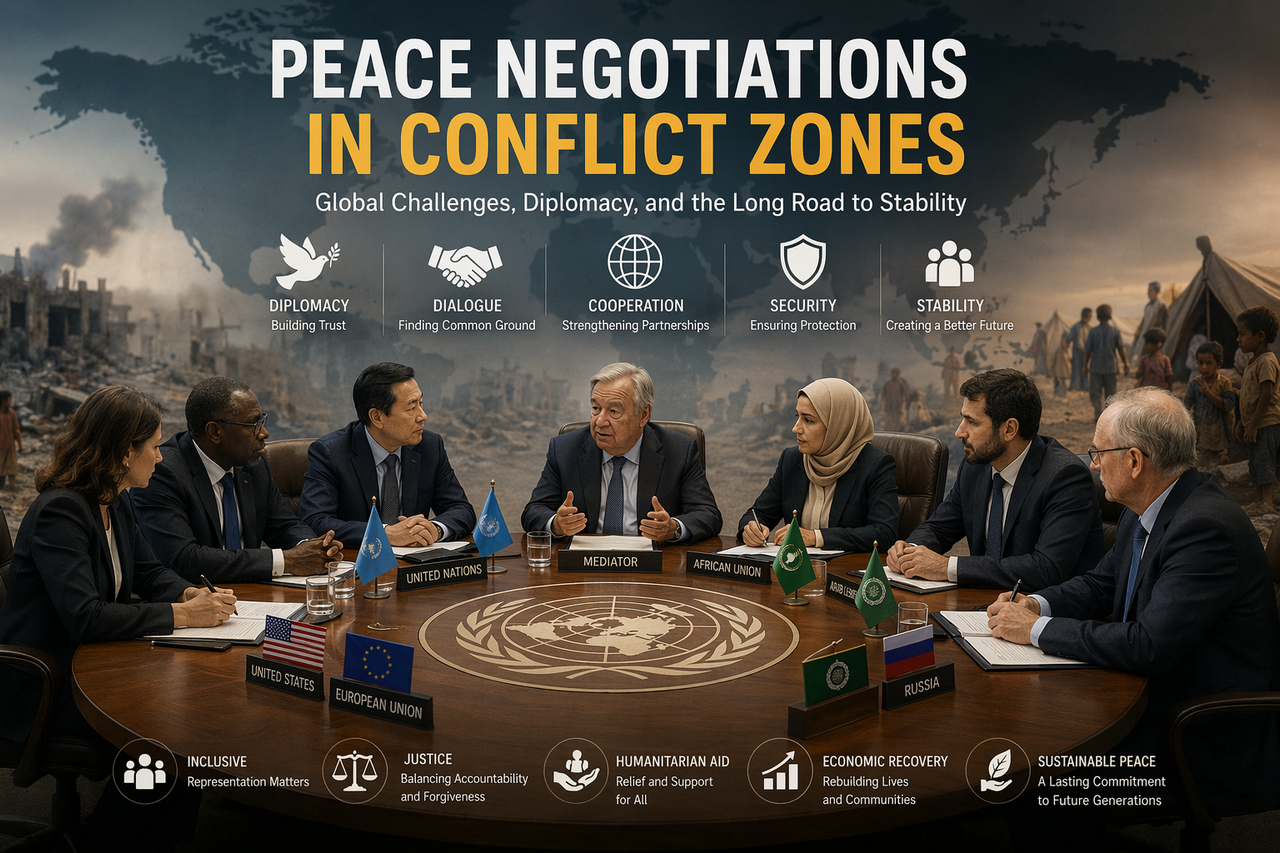
Peace Negotiations in Conflict Zones: Global Challenges, Diplomacy, and the Long Road to Stability
Introduction: The Silent Architecture of Peace
In the world’s most volatile regions, war dominates headlines, shapes economies, and displaces millions of lives. Yet behind the visible destruction of conflict lies a quieter and often less visible process: diplomacy.
Peace negotiations are the hidden architecture of global stability. They do not produce instant results, nor do they guarantee success. Instead, they represent years—sometimes decades—of careful dialogue, compromise, and political endurance.
From ceasefire talks in active war zones to long-term peace treaties designed to rebuild nations, negotiations remain the only structured pathway away from sustained violence. While military power may determine the direction of a conflict, diplomacy ultimately determines its conclusion.
However, in today’s interconnected and politically fragmented world, peace negotiations have become more complex than ever before.
The Changing Nature of Global Conflicts
Modern conflicts are no longer simple wars between two nation-states. Instead, they are multi-layered struggles involving regional powers, non-state actors, ideological movements, and global economic interests.
Several key patterns define contemporary conflicts:
1. Rise of Non-State Armed Groups
Militant organizations, insurgent movements, and paramilitary groups now play central roles in many conflicts. These groups often operate outside traditional diplomatic frameworks, making negotiations more difficult.
2. Proxy Wars and Foreign Influence
Global powers frequently support opposing sides in regional conflicts, turning local disputes into international power struggles.
3. Ethnic and Religious Divisions
Identity-based tensions continue to fuel long-standing conflicts in multiple regions.
4. Resource Competition
Access to water, oil, minerals, and agricultural land remains a major driver of instability.
5. Information Warfare
Digital propaganda, cyber operations, and misinformation campaigns now shape public perception and political decision-making.
As a result, peace negotiations must address not only military realities but also political, economic, and informational dimensions of conflict.
Why Peace Negotiations Matter in the Modern World
Despite increasing geopolitical tension, peace negotiations remain essential for several reasons:
- They prevent escalation into wider regional or global wars
- They provide humanitarian relief through ceasefires
- They create frameworks for long-term political stability
- They allow reconstruction and economic recovery
- They reduce displacement and human suffering
Even when negotiations fail, they often lay the groundwork for future agreements by establishing communication channels between opposing sides.
Case Study: Ukraine and the Limits of Wartime Diplomacy
The Russia-Ukraine conflict represents one of the most significant geopolitical crises in recent history. Since the escalation of hostilities in 2022, the war has reshaped global security structures, energy markets, and international alliances.
Diplomatic Efforts Amid Conflict
Despite ongoing military operations, several diplomatic initiatives have taken place:
- Prisoner exchange agreements
- Humanitarian corridor arrangements
- Grain export agreements to stabilize global food supply
- Intermittent peace talks facilitated by international mediators
These efforts demonstrate that diplomacy does not stop during war—it adapts to it.
Challenges to Comprehensive Peace
However, broader peace negotiations remain stalled due to:
- Territorial disputes
- Security guarantees and military alignment issues
- Deep political mistrust
- Competing narratives of sovereignty
The conflict illustrates a key reality of modern diplomacy: negotiations during active warfare are often limited to humanitarian and tactical agreements rather than full peace settlements.
The Middle East: A Region Defined by Cycles of Negotiation
Few regions illustrate the complexity of peace negotiations more than the Middle East.
The Israeli-Palestinian conflict, in particular, has experienced decades of diplomatic attempts, partial agreements, and repeated breakdowns.
A History of Repeated Negotiations
Over the years, various frameworks have been introduced to address:
- Territorial disputes
- Security arrangements
- Political recognition
- Economic cooperation
While some agreements have temporarily reduced tensions, long-term stability has remained elusive.
Why Negotiations Repeatedly Stall
Several factors contribute to the ongoing challenges:
- Leadership changes on both sides
- Internal political divisions
- Regional geopolitical pressures
- Periodic outbreaks of violence
- Lack of mutually trusted enforcement mechanisms
This conflict demonstrates that peace negotiations are not single events but continuous processes shaped by evolving political realities.
Sudan: The Fragility of Civil War Negotiations
In Sudan, internal conflict between competing military factions has created one of the most severe humanitarian crises in recent years.
Complex Nature of Internal Conflicts
Unlike interstate wars, civil conflicts often involve:
- Fragmented armed groups
- Shifting alliances
- Weak central authority
- Competing claims of legitimacy
- Mediation Challenges
International and regional actors have attempted to broker ceasefires and humanitarian access agreements. However, implementation has been inconsistent due to:
- Lack of enforcement mechanisms
- Distrust between factions
- Continuous battlefield changes
The Sudan crisis highlights how fragile peace agreements can be in the absence of stable governance structures.
Core Obstacles to Peace Negotiations Worldwide
Despite differences in geography and political context, most peace negotiations face similar structural challenges.
1. Deep Historical Mistrust
Years of violence create emotional and political barriers that are difficult to overcome.
2. Power Asymmetry
One party often believes it can achieve more through continued conflict than negotiation.
3. External Interference
Foreign states may support opposing sides for strategic reasons.
4. Spoiler Groups
Factions excluded from negotiations may actively disrupt peace efforts.
5. Justice vs. Peace Dilemma
Holding perpetrators accountable can conflict with the need to secure immediate ceasefires.
Balancing justice and stability remains one of the most complex issues in international diplomacy.
The Role of International Organizations in Peacebuilding
Global and regional organizations play a critical role in facilitating negotiations.
United Nations
The United Nations remains the most prominent actor in:
- Peacekeeping operations
- Diplomatic mediation
- Humanitarian coordination
- Conflict monitoring
- Regional Organizations
Entities such as the African Union, European Union, and Arab League also contribute to mediation efforts based on regional proximity and political influence.
Independent Mediators
In many cases, neutral countries or experienced diplomats serve as third-party mediators to facilitate dialogue.
What Makes Peace Negotiations Successful?
While many peace talks fail, successful agreements tend to share common characteristics:
1. Step-by-Step Implementation
Gradual agreements are more durable than immediate comprehensive deals.
2. Monitoring and Verification
Independent oversight ensures compliance with agreements.
3. Political Commitment
Strong leadership support is essential for long-term success.
4. Incentive Structures
Economic aid, sanctions relief, or reconstruction support often encourage cooperation.
5. International Guarantees
External guarantees reduce fears of betrayal or renewed aggression.
Ceasefire Agreements vs. Comprehensive Peace Deals
Understanding the difference between these two types of agreements is essential.
Ceasefire Agreements
- Temporary halt in fighting
- Focus on immediate violence reduction
- Often fragile and short-term
Comprehensive Peace Agreements
- Address root causes of conflict
- Include political, legal, and economic reforms
- Aim for long-term stability
History shows that ceasefires without political solutions are unlikely to last.
Economic Reconstruction: The Foundation of Lasting Peace
Peace cannot be sustained without economic recovery.
Post-conflict reconstruction typically involves:
- Infrastructure rebuilding
- Job creation programs
- Education system restoration
- Healthcare system rehabilitation
- Anti-corruption reforms
International donors often tie financial assistance to governance reforms to ensure accountability.
Economic collapse after peace agreements can quickly lead to renewed instability.
The Impact of Technology on Peace Negotiations
Technology has significantly transformed modern diplomacy.
Positive Impacts
- Secure digital communication channels
- Faster coordination between mediators
- Real-time humanitarian monitoring
Negative Impacts
- Spread of misinformation
- Public pressure on negotiation teams
- Online polarization and propaganda
Social media can both support and undermine peace processes depending on how information is managed.
Climate Change as a Conflict Multiplier
Climate-related challenges are increasingly linked to conflict dynamics.
Issues such as:
- Water scarcity
- Agricultural decline
- Forced migration
- Resource competition
can increase tensions in already fragile regions.
Future peace negotiations are likely to incorporate environmental governance as a core component of agreements.
Global Power Competition and Its Influence on Peace
Geopolitical rivalries between major powers significantly influence peace negotiations.
When major powers cooperate, peace processes are more effective. However, when they compete, negotiations often become more complicated or prolonged.
Diplomatic unity among global actors is often a decisive factor in achieving sustainable peace agreements.
Long-Term Lessons from Peace Processes
History provides several key lessons:
- Peace is a gradual process, not an instant outcome
- Partial agreements can build momentum for larger deals
- Enforcement is more important than signing ceremonies
- Inclusive participation improves long-term stability
- Economic recovery is essential for preventing relapse into conflict
Many successful peace agreements were once considered impossible before they were achieved.
Conclusion: The Future of Peace Negotiations
Peace negotiations remain one of the most challenging yet essential components of global diplomacy.
While modern conflicts are more complex than ever, involving multiple actors and overlapping interests, negotiation remains the only sustainable alternative to prolonged warfare.
The future of peacebuilding will depend on:
- Stronger international cooperation
- Inclusive political frameworks
- Integration of climate and economic issues
- Technological adaptation in diplomacy
- Long-term commitment to post-conflict recovery
Although the path to peace is rarely direct, history shows that dialogue—however slow or imperfect—remains humanity’s most powerful tool for ending conflict.



Comments
Post a Comment