Artemis II: Why This Mission Could Redefine Humanity’s Future in Space
For decades, space exploration has represented one of humanity’s boldest ambitions. From early rocket experiments to the historic moment of the Apollo 11 Moon Landing, we have always pushed beyond what once seemed impossible.
Now, after more than 50 years, we are preparing to return—not just to space, but to deep space. At the center of this effort is Artemis II, a mission that will carry astronauts around the Moon and mark the true beginning of a new era.
In my view, this mission is not just about repeating history. It’s about correcting a long pause in human exploration and setting a direction for the future.
Looking Back: Why the Moon Still Matters
To understand why Artemis II is important, we need to revisit the era of the Apollo missions. During that time, humanity achieved something extraordinary—landing people on another world.
But after Apollo 17, everything stopped.
The reasons were mostly political and economic. Governments shifted priorities, funding decreased, and the urgency of the space race faded. As a result, human missions remained limited to low Earth orbit for decades.
Personally, I think this pause slowed down our progress as a species. We had the momentum—but we didn’t continue.
Artemis II represents a return to that lost momentum.
A New Direction with the Artemis Program
The Artemis program, led by NASA, is not just about going back to the Moon—it’s about staying there and building something sustainable.
Its goals are clear:
- Return humans to the Moon
- Build a long-term presence
- Prepare for Mars missions
- Encourage global cooperation
What stands out to me is the shift in mindset. This isn’t about proving superiority like during the Cold War. It’s about long-term survival, science, and shared progress.
What Makes Artemis II So Important?
Artemis II is the first mission in this program that will carry humans. While Artemis I tested the systems without astronauts, Artemis II will prove whether those systems are truly ready for human life.
The mission will send four astronauts around the Moon and back to Earth.
That may sound simple—but it’s actually one of the most critical steps in modern space exploration.
In my opinion, Artemis II is like a “final exam” before humanity returns to walking on the Moon.
What This Mission Needs to Prove
Artemis II is not just symbolic—it has serious technical responsibilities.
It must demonstrate that humans can safely travel far beyond Earth’s protective environment. This includes dealing with radiation, isolation, and extreme distances.
It also needs to confirm that spacecraft systems—navigation, communication, and life support—work perfectly under real conditions.
If anything fails here, future missions like Artemis III could be delayed.
A Crew That Reflects the Modern World
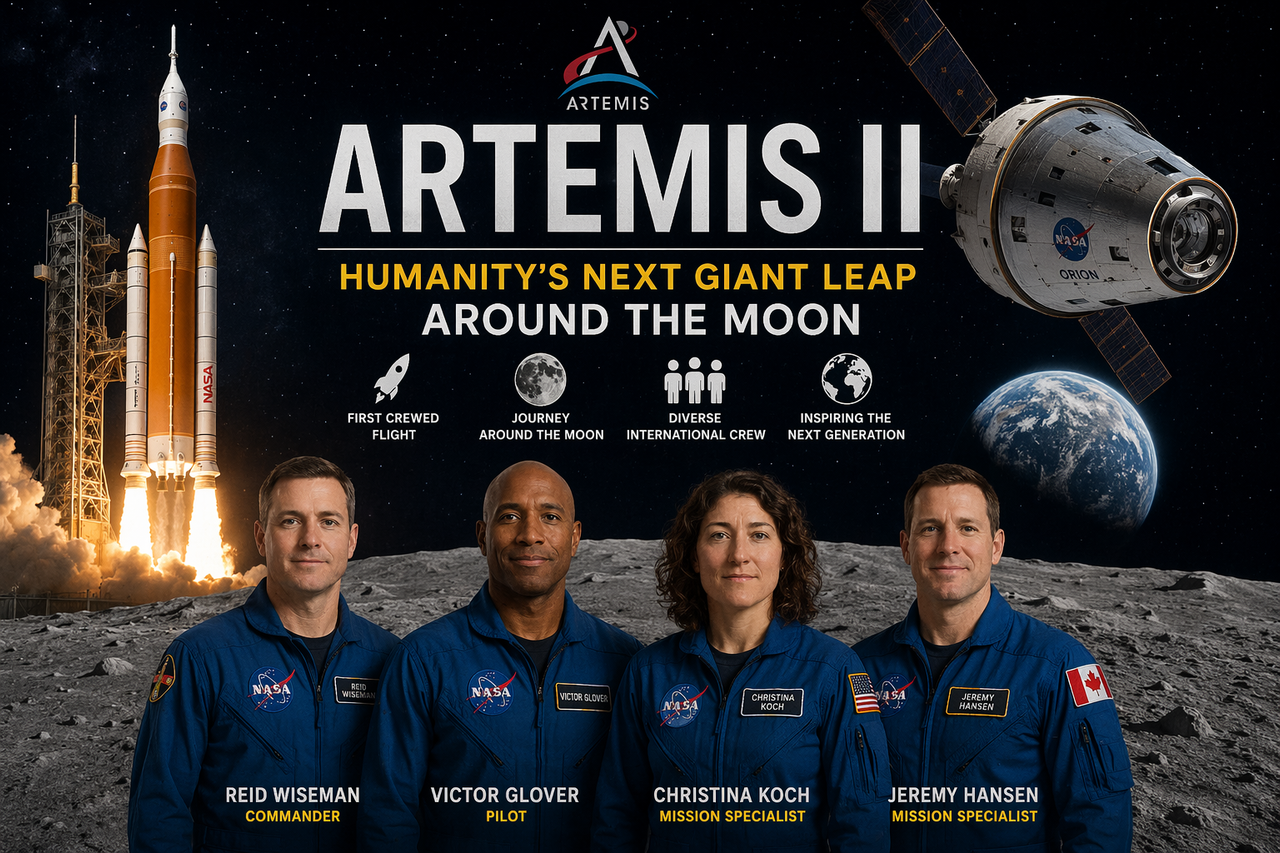
One of the most refreshing aspects of Artemis II is its crew:
- Reid Wiseman
- Victor Glover
- Christina Koch
- Jeremy Hansen
This mission includes historic milestones:
- The first woman to travel to the Moon
- The first Black astronaut on a lunar mission
- The first non-American astronaut to go this far
With involvement from the Canadian Space Agency, it’s clear that space exploration is no longer limited to one country.
I personally think this diversity makes the mission more meaningful. It shows that space belongs to everyone.
Technology That Makes It Possible
Two major technologies power Artemis II:
Space Launch System
The Space Launch System is designed to carry humans beyond Earth orbit. It’s incredibly powerful and built specifically for deep space missions.
Orion Spacecraft
The Orion spacecraft will carry the crew. It includes modern life-support systems, radiation protection, and advanced navigation.
Compared to Apollo-era technology, this is a massive upgrade. In my opinion, Orion represents the future of human space travel.
The Journey Around the Moon
The mission itself will follow a carefully planned path:
- Launch from Earth
- Orbit briefly for checks
- Travel toward the Moon
- Fly around the far side
- Return to Earth
The crew will travel over 400,000 kilometers away.
That distance is hard to imagine. It’s a reminder of how far humans are willing to go to explore.
The Reality: Space Is Still Dangerous
Despite all the advancements, space travel remains risky.
Astronauts will face:
- Higher radiation levels
- Limited communication
- No immediate rescue options
Even a small technical failure could have serious consequences.
In my view, this is what makes Artemis II so important. If we don’t face these challenges now, we can’t move forward.
A Truly Global Mission
Artemis II involves international partners like:
- European Space Agency
- Japan Aerospace Exploration Agency
- Canadian Space Agency
This level of cooperation is something we didn’t see during the Apollo era.
I believe this is the future. Space exploration should unite countries, not divide them.
Why the Moon Is Still the Focus
Some people ask: why go back to the Moon?
The answer is simple.
The Moon can help us:
- Test technologies for Mars
- Study the early solar system
- Explore resources like water ice
Personally, I see the Moon as a “practice ground” for bigger missions.
Then vs Now: Apollo and Artemis
There’s a clear difference between past and present missions.
Apollo was about reaching the Moon first.
Artemis is about staying, learning, and expanding.
That shift—from short-term success to long-term planning—is what makes Artemis II so important.
When Will It Launch?
The mission is expected in the mid-2020s, though delays are always possible in complex projects like this.
What Comes Next?
Artemis II is only one step.
Future plans include:
- Landing humans on the Moon again
- Building a lunar space station
- Preparing for Mars missions
Each step builds on the last.
Why This Matters for People Like Us
Even if you’re not directly involved in space science, missions like Artemis II still matter.
They:
- Inspire students
- Create new technologies
- Open future job opportunities
For developing countries, including Bangladesh, this is especially important. It shows that science and innovation are global—and anyone can be part of the future.
The Bigger Goal: Reaching Mars
Everything about Artemis II connects to a bigger dream—sending humans to Mars.
This mission helps test the systems, technology, and human endurance needed for that journey.
In my opinion, Mars is not just another destination. It represents humanity’s next home beyond Earth.
Final Thoughts
Artemis II is more than just a technical mission. It’s a statement about where humanity is heading.
We are no longer satisfied with staying close to Earth. We are ready to explore, to expand, and to build a future beyond our planet.
And honestly, this feels like the beginning of something much bigger than we can fully understand right now.
The journey has restarted—and this time, we might not stop again.
You can read more:
-Future of Space Exploration: Humans on Mars and the Next Era of Space Travel
-Who Controls AI? Europe, US, and China in a Global Tech Battle
-



Comments
Post a Comment