The 2026 Global Oil Shock: War, Supply Chains, and the Fragile Future of Energy
Introduction: A Market on Edge
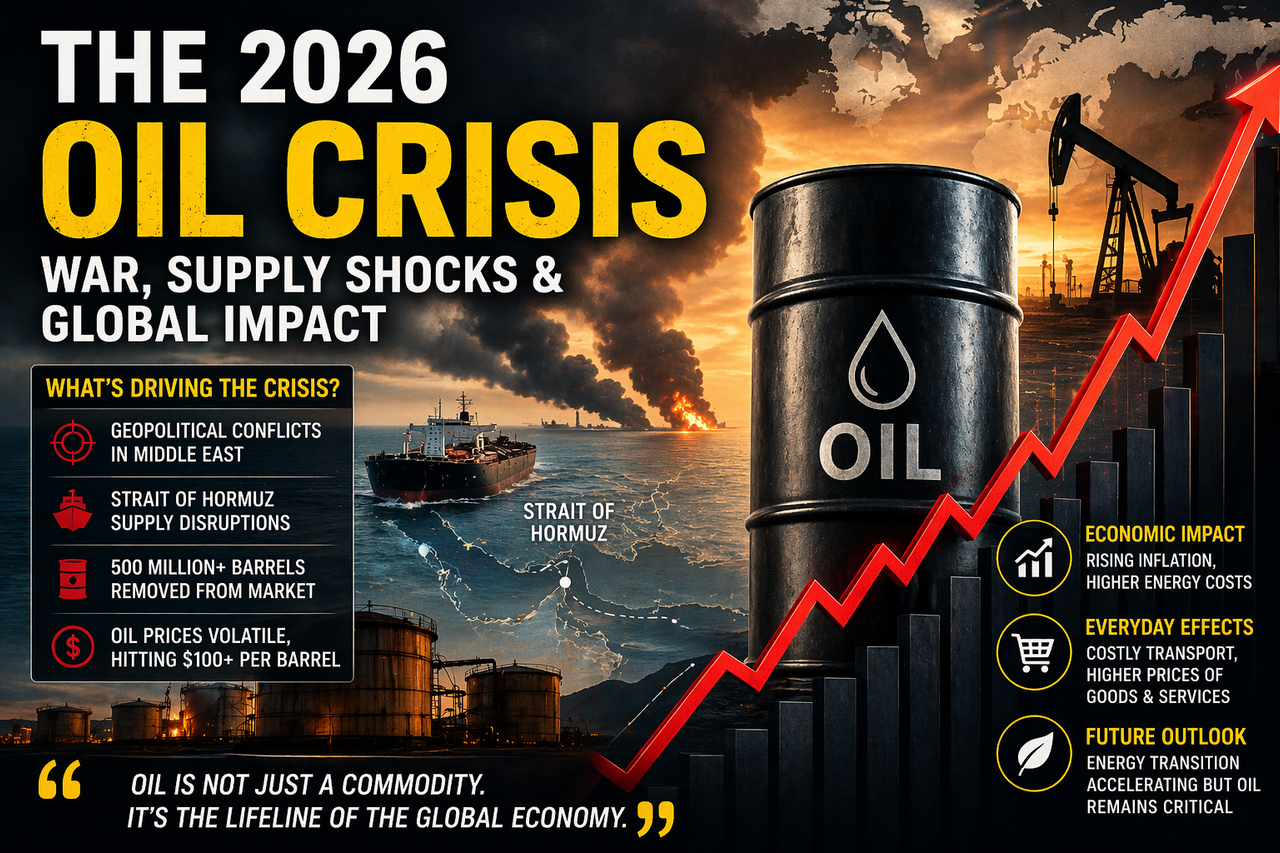
In 2026, the global oil market is once again at the center of geopolitical and economic tension. What initially appeared to be a temporary disruption has evolved into a complex and persistent crisis, shaped by conflict, supply constraints, and structural shifts in global energy demand.
Oil prices have surged, retreated, and surged again within months, reflecting a level of volatility not seen in years. Behind these fluctuations lies a deeper reality: the global oil system is becoming increasingly fragile, exposed to geopolitical shocks and structural imbalances that traditional market mechanisms struggle to absorb.
At the heart of this instability is the strategic importance of the Strait of Hormuz, through which a significant portion of the world’s oil supply flows. Any disruption in this region sends immediate shockwaves across global markets.
Opinion Insight:
The 2026 oil crisis is not just about supply and demand—it is about control, vulnerability, and the limits of globalization in an era of geopolitical tension.
1. The Geopolitical Trigger: Conflict and Energy Disruption
The current oil shock cannot be understood without examining the geopolitical tensions that have destabilized key production and transit regions.
Escalating conflict in the Middle East, particularly involving Iran, has directly impacted oil flows. Military tensions, sanctions, and threats to shipping lanes have created an environment of uncertainty that markets respond to instantly.
Even temporary disruptions in oil exports can have outsized effects. The loss of hundreds of millions of barrels from global supply chains has tightened markets, pushing prices upward and amplifying volatility.
Opinion Insight:
Oil is not just a commodity—it is a geopolitical instrument. In times of conflict, energy becomes both a weapon and a vulnerability.
2. The Strait of Hormuz: The World’s Energy Pressure Point
Few locations are as strategically significant as the Strait of Hormuz. This narrow waterway connects the Persian Gulf to global markets and carries roughly one-fifth of the world’s oil supply.
Any threat to its stability—whether through military activity, blockades, or political tension—immediately affects global energy prices.
In 2026, even rumors of disruption have been enough to trigger price spikes. Insurance costs for oil tankers have risen, shipping routes have been adjusted, and global supply chains have been forced to adapt.
Opinion Insight:
The Strait of Hormuz represents a structural weakness in the global energy system. As long as such chokepoints exist, true energy security will remain elusive.
3. Price Volatility: A Market Without Stability
One of the defining features of the 2026 oil crisis is extreme price volatility.
Oil prices have fluctuated dramatically:
- Rapid increases driven by geopolitical fears
- Sudden declines following diplomatic developments
- Ongoing instability due to uncertain supply conditions
This volatility reflects a deeper imbalance. The market is no longer responding purely to fundamentals; it is reacting to expectations, risks, and uncertainty.
Opinion Insight:
Modern oil markets are driven as much by perception as by reality. Fear, speculation, and geopolitical signaling now play a central role in price formation.
4. The Hidden Cost of Oil: Beyond the Barrel Price
While headline oil prices dominate discussions, they often fail to capture the true cost of energy.
Behind the scenes, additional pressures are building:
- Rising transportation and insurance costs
- Refinery capacity constraints
- Logistical inefficiencies
These factors create a “hidden price” of oil that affects economies even when official prices appear stable.
Consumers feel this through:
- Higher electricity bills
- Increased transportation costs
- Rising prices of goods and services
Opinion Insight:
The real oil crisis is not just what we see at the pump—it is the cascading economic impact that spreads across every sector.
5. Supply Chains Under Stress
Global oil supply chains are under unprecedented strain. Disruptions at any point—from extraction to transportation—can ripple across the entire system.
Key challenges include:
- Limited spare production capacity
- Aging infrastructure in some regions
- Increased geopolitical risk in major producing areas
Countries are now reassessing their energy strategies, focusing on:
- Diversification of supply sources
- Strategic reserves
- Domestic production capabilities
Opinion Insight:
Efficiency once defined global supply chains. Today, resilience has become the priority—even if it comes at a higher cost.
6. Demand Dynamics: Slowing Growth, Persistent Pressure
On the demand side, the picture is equally complex.
High oil prices have led to:
- Reduced consumption in some regions
- Increased interest in alternative energy sources
- Behavioral changes among consumers
However, global demand remains strong, driven by:
- Emerging economies
- Industrial activity
- Transportation needs
Opinion Insight:
Demand is not collapsing—it is adapting. The world still depends heavily on oil, even as it seeks alternatives.
7. Economic Consequences: Inflation and Beyond
The impact of rising oil prices extends far beyond the energy sector.
Higher oil costs contribute to:
- Inflation
- Increased production costs
- Reduced consumer spending
For developing countries, the effects are particularly severe. Fuel price increases can strain public finances and trigger broader economic challenges.
Opinion Insight:
Oil is the backbone of the global economy. When its price rises, the entire system feels the pressure.
8. The Energy Transition Paradox
The current crisis has reignited debates about the transition to renewable energy.
On one hand, high oil prices:
- Encourage investment in renewables
- Accelerate innovation in clean energy
On the other hand:
- Short-term reliance on oil remains unavoidable
- Infrastructure for alternatives is still developing
Opinion Insight:
The world is caught in a paradox: it needs oil today while trying to move beyond it tomorrow.
9. Strategic Competition and Energy Politics
Energy has always been a source of geopolitical competition, but in 2026, this competition is intensifying.
Major powers are:
- Securing long-term supply agreements
- Investing in energy infrastructure abroad
- Using energy policy as a diplomatic tool
This competition shapes global alliances and influences diplomatic decisions.
Opinion Insight:
-Energy politics is no longer a subset of geopolitics—it is one of its central pillars.
10. The Future of Oil Markets
Looking ahead, several trends are likely to define the future of oil:
- Continued geopolitical uncertainty
- Increasing market volatility
- Gradual shift toward alternative energy sources
- Greater emphasis on energy security
Technological innovation, policy decisions, and global cooperation will all play roles in shaping this future.
Opinion Insight:
The oil market of the future will be less predictable, more complex, and deeply intertwined with global politics.
Conclusion: A System Under Pressure
The 2026 oil crisis highlights the fragility of the global energy system. It reveals how interconnected—and vulnerable—modern economies have become.
While markets may stabilize in the short term, the underlying challenges remain:
- Geopolitical risk
- Supply chain vulnerabilities
- Structural dependence on fossil fuels
Final Thought:
The question is not whether another oil crisis will occur, but how prepared the world will be when it does.
In this evolving landscape, adaptability, resilience, and strategic foresight will determine which nations and economies thrive—and which struggle to keep pace.
You can read more:
-Global Diplomatic Maneuvers Intensify in 2026: Trade Tensions, Tech Regulation & the Reshaping of World Order
-Diplomacy Trends in a Multipolar World 2026: Global Power Shifts Explained
-How Middle East Tensions Affect Oil Prices and the Global Economy
-Diplomacy Trends in a Multipolar World 2026: Global Power Shifts Explained



Comments
Post a Comment